
Urgent Care vs. Emergency Room: Choosing the Right Setting Saves Real Money

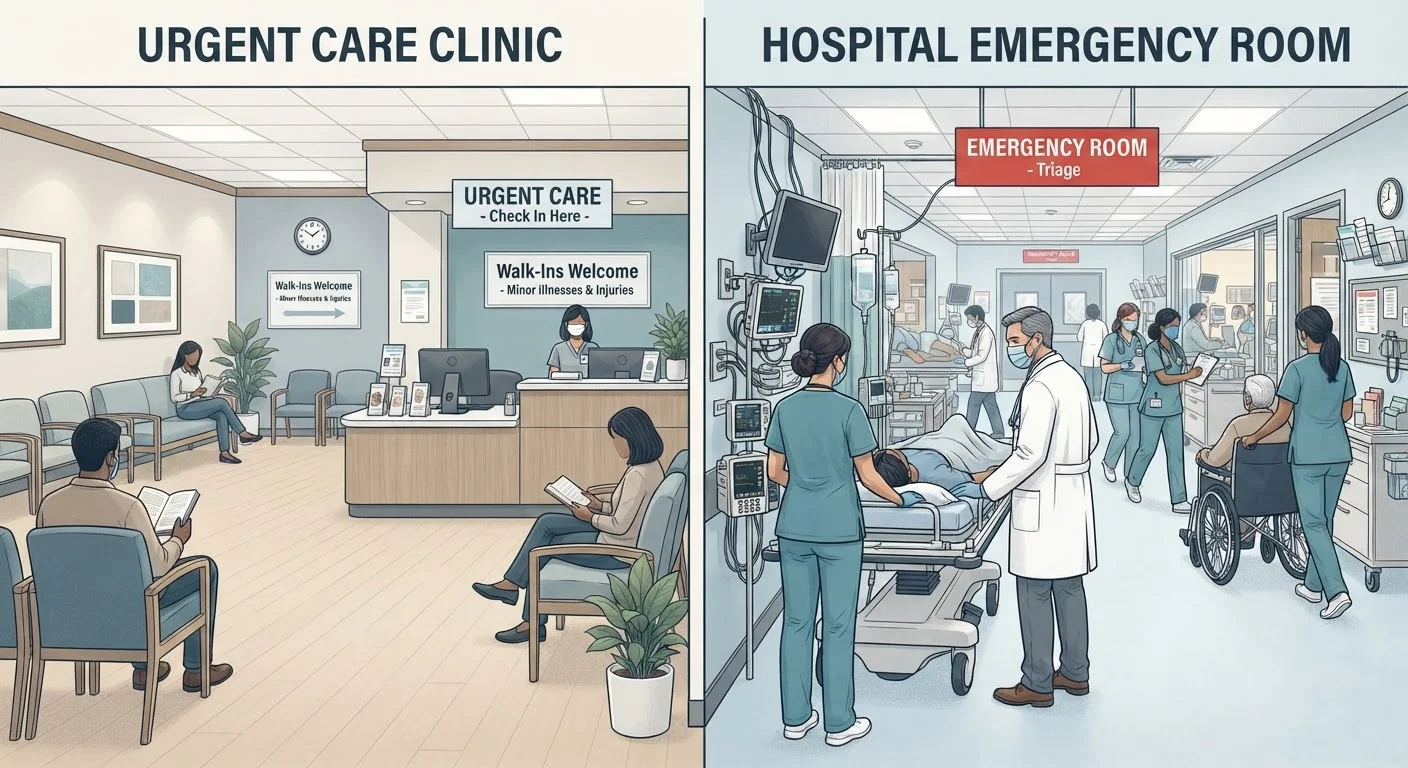
Photo: InsightsVault.com | Interesting Daily Reads editorial
Key Takeaways
- ER visits for non-emergencies can cost several times more than the equivalent urgent care visit.
- Urgent care centers handle a wide range of common illnesses and minor injuries effectively.
- Chest pain, stroke symptoms, severe bleeding, and difficulty breathing always warrant a 911 call or ER visit.
- Your insurance copay structure often reflects this difference - ER copays are typically much higher.
- Knowing which setting fits your situation before you need it can help you avoid costly, avoidable ER visits.
Why the Setting You Choose Matters Financially
For many Americans, a sudden illness or injury triggers an instinct to head straight to the nearest emergency room. It feels like the safest choice. But when the condition isn't a true emergency, that decision can come with a significant and avoidable financial cost.
Hospital ERs are built for critical, complex care. They maintain 24/7 specialist coverage, advanced imaging suites, trauma teams, and intensive care capability. All of that infrastructure is expensive to run - and those costs flow through to patients. Urgent care centers, by contrast, are designed for exactly the middle ground: conditions that can't wait for a routine appointment but don't require the resources of a full hospital.
The financial gap is substantial. According to research published by the Health Care Cost Institute and widely cited in health policy discussions, the average ER visit for a condition classified as non-emergent costs several times more than the same condition treated at an urgent care clinic. For someone with high-deductible insurance - or no insurance - that difference can mean hundreds or even thousands of dollars.
Understanding this gap is a core part of managing your health costs proactively. As explored in our guide to treatment versus prevention costs, the choices you make when symptoms first appear shape the bill you'll face later.
| Criterion | Urgent Care Center | Emergency Room (ER) |
|---|---|---|
| Typical cost (uninsured estimate) | $100-$200 | $500-$3,000+ |
| Typical insurance copay | $40-$75 | $250-$350+ |
| Average wait time | 15-45 minutes | 1-4+ hours |
| Imaging available | X-ray (most locations) | X-ray, CT, MRI, ultrasound |
| Hours of operation | Extended hours, not 24/7 | 24 hours, 7 days |
| Admission capability | No | Yes |
| Best for | Non-life-threatening illnesses/injuries | Life- or limb-threatening emergencies |
What Each Setting Is Actually Equipped to Handle
Urgent care centers are staffed by licensed physicians, nurse practitioners, and physician assistants. Most can perform blood draws, urinalysis, rapid strep and flu tests, EKGs, and X-rays. They can treat lacerations, prescribe medications, manage infections, and handle moderate orthopedic injuries. What they generally cannot do is provide IV medications for serious conditions, perform emergency surgery, or admit patients overnight.
Emergency rooms are staffed around the clock with emergency medicine physicians and have access to CT scanners, MRI machines, cardiac catheterization labs, surgical suites, and full specialist backup. They are the right place when minutes matter.
~$2,200
Median ER visit cost (all payers)
Research from the Health Care Cost Institute suggests median ER costs are many times higher than equivalent urgent care visits for the same condition.
27%
ER visits classified as non-emergent
Studies published in peer-reviewed emergency medicine journals estimate roughly one in four ER visits involves a condition treatable in a lower-acuity setting.
3-5x
Cost difference: ER vs. urgent care
Health economists consistently find non-emergent ER visits cost three to five times more than equivalent urgent care treatment for the same condition type.
A useful internal question to ask: Could this wait safely until tomorrow? If yes, urgent care or your primary care provider is likely appropriate. If no - or if the answer is genuinely unclear because symptoms are severe or rapidly changing - err toward the ER or call 911.
Conditions that always warrant the ER or 911: chest pain or pressure, stroke symptoms (facial drooping, arm weakness, speech difficulty), severe shortness of breath, uncontrolled bleeding, seizures, serious head injuries, overdose, or altered consciousness.
Conditions well-suited to urgent care: sore throat, ear pain, sinus infections, urinary tract infections, mild to moderate asthma flare-ups, skin rashes, minor burns, animal bites requiring wound care, sprains, and simple fractures.
How Insurance Copays Reflect the Cost Difference
Most employer-sponsored and marketplace insurance plans build the urgent care vs. ER distinction directly into their cost-sharing structure. A typical plan might charge a $40-$75 copay for urgent care but $250-$350 or more for an ER visit - before coinsurance and deductibles apply. For someone who hasn't met their deductible, the actual out-of-pocket difference can be even larger.
It's worth reviewing your specific plan's Summary of Benefits to understand your exact cost structure. If you use an out-of-network urgent care center, the economics shift - always confirm network status before visiting when possible.
Telehealth: A Third Option Worth Knowing
The broader lesson here mirrors the principle behind preventive care: decisions made earlier in a health episode - including where to seek care - tend to carry lower financial consequences. Our Preventive Care 101 overview explains how this logic extends to routine health maintenance as well.
This article is for general informational purposes only and does not constitute medical advice. Always consult a qualified healthcare professional for guidance specific to your health situation. In a potential emergency, call 911 or go to your nearest emergency room immediately.
The content provided on our blog site traverses numerous categories, offering readers valuable and practical information. Readers can use the editorial team’s research and data to gain more insights into their topics of interest. However, they are requested not to treat the articles as conclusive. The website team cannot be held responsible for differences in data or inaccuracies found across other platforms. Please also note that the site might also miss out on various schemes and offers available that the readers may find more beneficial than the ones we cover.