
Programmable vs. Smart Thermostats: Matching the Technology to Your Household

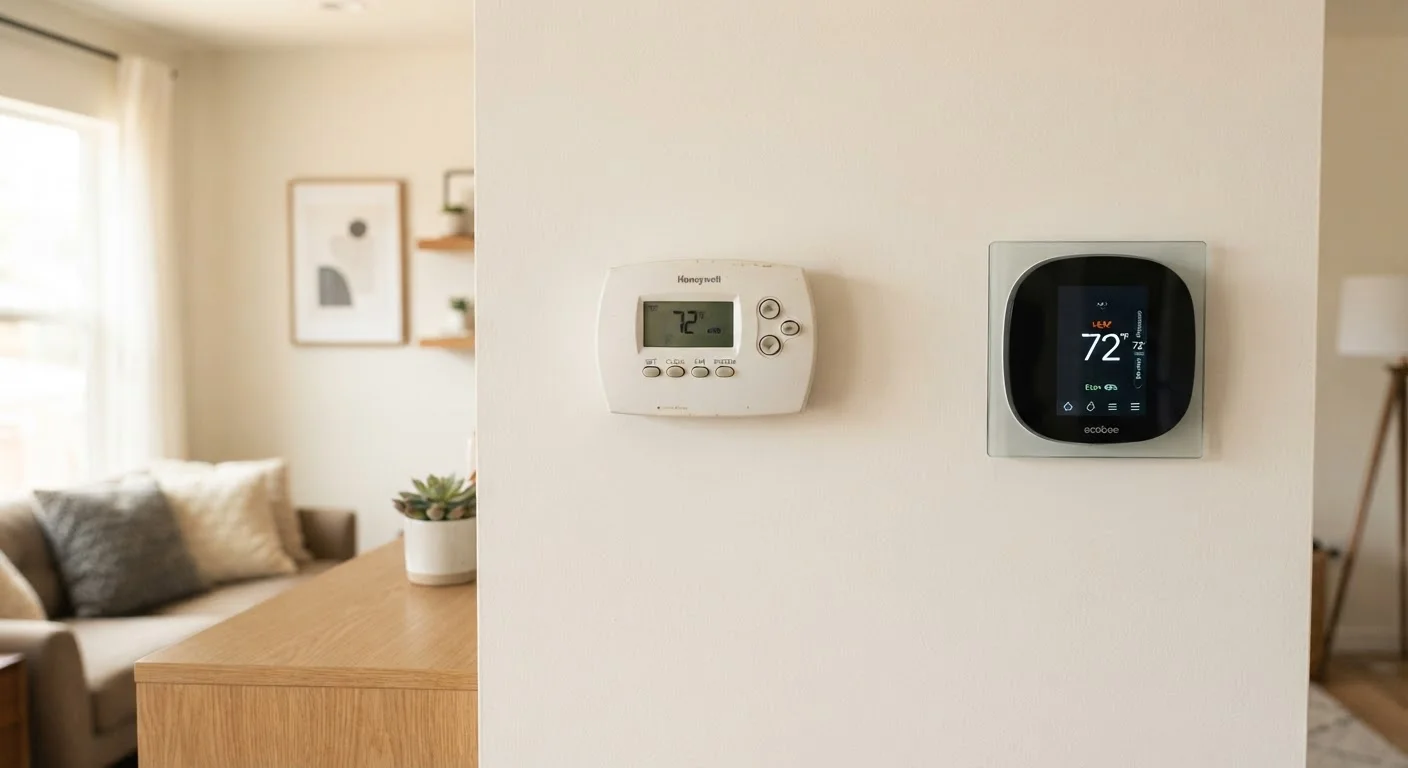
Photo: InsightsVault.com | Interesting Daily Reads editorial
Key Takeaways
- Programmable thermostats cost less upfront and work reliably without Wi-Fi or smartphone access.
- Smart thermostats can learn household patterns and adjust automatically, potentially improving savings over a basic programmed schedule.
- Utility rebates often offset smart thermostat costs - check your provider before purchasing either type.
- Correct installation and a well-configured schedule matter more than the device itself for actual energy savings.
- Neither thermostat delivers savings if the home has significant air leaks or poor insulation - address those first.
How Each Thermostat Actually Works
A programmable thermostat lets you set target temperatures for specific time blocks - typically morning, day, evening, and night - across weekdays and weekends separately. Once configured, it runs that schedule indefinitely with no further input. Most models use a simple keypad or button interface and store settings in onboard memory, so they function independently of any network or device.
A smart thermostat connects to your home Wi-Fi and pairs with a smartphone app. Beyond basic scheduling, it can detect occupancy using built-in sensors or phone GPS, factor in local weather forecasts, and - in learning models - build a schedule automatically by observing when you adjust the temperature manually. Energy-use reports are typically available through the app or a web dashboard.
Both types control your HVAC system the same way: they signal the furnace or air conditioner to run or stop based on the gap between the current room temperature and the target. The difference is entirely in how that target is set and adjusted. For a broader look at where thermostat choices fit within a full efficiency strategy, see the year-round home energy roadmap.
| Criterion | Programmable Thermostat | Smart Thermostat |
|---|---|---|
| Typical upfront cost | $25-$80 | $130-$250+ |
| Wi-Fi / app required | No | Yes |
| Remote access | Not available | Via smartphone app |
| Occupancy detection | Not available | Available on most models |
| Self-learning capability | No | Available on select models |
| Energy usage reports | Not available | Available via app/dashboard |
| Utility rebate eligibility | Rarely | Commonly (varies by utility) |
| Installation complexity | Low - most are DIY-friendly | Moderate - may need C-wire |
Costs, Savings, and the Rebate Factor
Programmable thermostats generally range from roughly $25 to $80. Smart thermostats typically cost $130 to $250 or more, depending on features. That upfront gap is real, but many electric and gas utilities offer rebates specifically for qualifying smart thermostats - sometimes $50 to $100 or more - which can significantly narrow the difference. Check your utility's website or call their energy efficiency line before making a decision.
~10%
Potential annual HVAC savings from setback scheduling
The U.S. Department of Energy estimates savings of around 10% per year by adjusting the thermostat 7-10°F for 8 hours daily.
$50-$100+
Typical utility rebate for qualifying smart thermostats
Many U.S. electric and gas utilities offer rebates to encourage smart thermostat adoption - amounts vary widely by provider and region.
40-50%
Share of home energy use attributed to heating and cooling
According to the U.S. Energy Information Administration, heating and cooling typically account for the largest portion of household energy consumption.
The U.S. Department of Energy notes that turning your thermostat back 7-10°F from its normal setting for 8 hours a day can reduce heating and cooling costs by around 10% annually. Both thermostat types can achieve this - the question is which one actually will, given your household's habits. A programmable thermostat that never gets properly configured won't outperform a manual one. A smart thermostat left on default settings may not do much better.
If your home has drafty windows, insufficient insulation, or duct leaks, neither device will deliver meaningful savings on its own. Before upgrading your thermostat, it's worth reviewing foundational energy efficiency steps to make sure the basics are covered.
Where Each Falls Short
Programmable thermostats fail in practice when households don't take the time to configure them correctly, or when schedules are irregular enough that a fixed program wastes energy. Studies have found that many programmable thermostats are either misconfigured or left in a manual hold mode, which eliminates any efficiency advantage. They also offer no recovery mechanism if you forget to adjust before an unexpected day away from home.
Smart thermostats introduce complexity. They require a stable Wi-Fi connection, a compatible HVAC system (some older systems lack the C-wire needed to power a smart model), and a willingness to manage an app and periodic software updates. Learning models take several weeks to stabilize their schedule, during which heating and cooling behavior may feel unpredictable. Privacy-conscious households should also review what data the thermostat collects and how it's used.
For room-by-room energy habits that work alongside any thermostat type, the energy-efficient practices by room guide is a practical companion resource.
C-Wire Compatibility: Check Before You Buy
The content provided on our blog site traverses numerous categories, offering readers valuable and practical information. Readers can use the editorial team’s research and data to gain more insights into their topics of interest. However, they are requested not to treat the articles as conclusive. The website team cannot be held responsible for differences in data or inaccuracies found across other platforms. Please also note that the site might also miss out on various schemes and offers available that the readers may find more beneficial than the ones we cover.