
Reading a Deal: Decoding Fine Print, Exclusions, and Expiry Dates

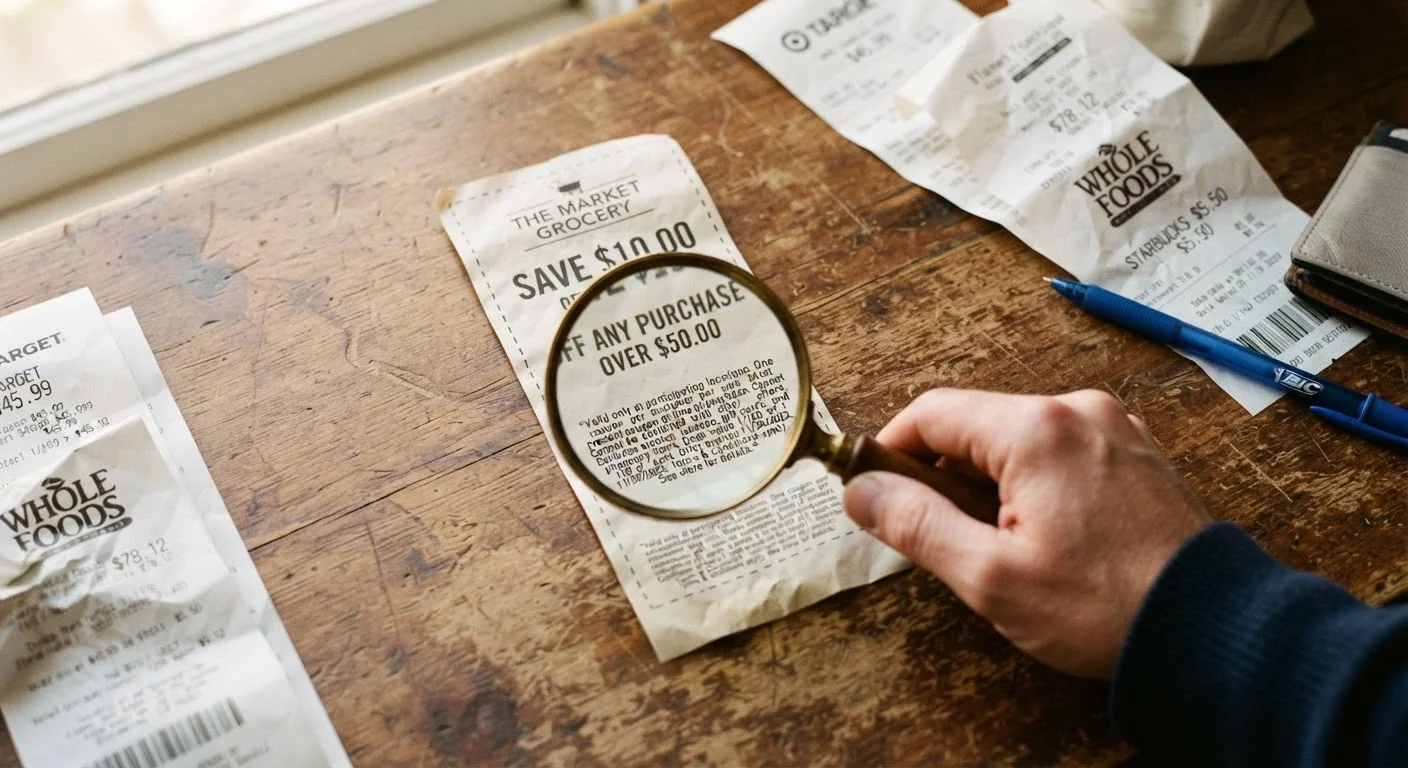
Photo: InsightsVault.com | Interesting Daily Reads editorial
Why Fine Print Exists - and What It's Actually Doing
Every discount has a cost to the issuer. Fine print is how retailers and manufacturers control that cost by defining the exact transaction they're willing to subsidize. Understanding this - explored further in our breakdown of how coupons are issued - reframes the terms from obstacles into a specification. The deal covers this product, this size, this price point, under these conditions.
Four elements do the most work inside any coupon or promo code's terms: qualifying product rules, exclusions, minimum purchase thresholds, and expiry conditions. Misreading any one of them is enough to get a discount rejected at the register or at checkout.
| Most common exclusion type | Already-discounted or clearance items |
| Minimum purchase clause format | Dollar amount threshold (e.g., '$50 or more') |
| Where expiry dates appear | Bottom or reverse side of physical coupon; 'Terms & Conditions' for digital codes |
| Single-use code behavior | Deactivated in retailer's system upon first redemption |
| Standard stacking rule | One manufacturer coupon + one store coupon per qualifying item |
| Rain check availability | Store-by-store policy; not universally offered |
Decoding the Most Common Clauses
Qualifying Products and Sizes
Coupons tied to a specific product are almost always size- or count-specific. A coupon for a 32 oz. bottle won't apply to the 16 oz. version - same brand, wrong SKU. When a coupon says "any variety," that typically means flavor or scent, not size or format. Check the barcode reference or product description line in the terms.
Exclusions
"Not valid on clearance, sale items, or items already reduced" is the most common exclusion - and the most frequently overlooked. Other common carve-outs include trial sizes, gift sets, and specific product sub-lines. If a coupon covers "select styles," treat that as a signal that meaningful portions of the category are excluded.
When a Coupon Meets a Sale Price
Minimum Purchase Thresholds
Thresholds almost always apply to the pre-tax eligible subtotal. Excluded items don't count toward the minimum. Buying $45 of qualifying goods and $10 of excluded items won't satisfy a $50 threshold - the $10 simply doesn't count.
Expiry Dates and Activation Windows
Physical coupons display a clear expiry date. Digital codes are trickier: they may expire at midnight in the retailer's local time zone, not yours. Some codes also carry an activation date - issued in advance but not yet valid. Attempting redemption before the window opens triggers the same rejection as an expired code. Always verify both ends of the validity window.
Stacking, Single-Use Codes, and Per-Transaction Rules
"One coupon per transaction" and "one coupon per customer" are meaningfully different restrictions. Per-transaction limits control how many discounts apply to a single purchase. Per-customer limits - typically enforced by email address, loyalty account, or device fingerprint - restrict how often an individual can use a code across any number of purchases.
Stacking is governed by store policy and coupon type. The general convention in U.S. retail: one manufacturer coupon and one store coupon per qualifying item. Retailer apps and loyalty programs sometimes add a third eligible layer (a "store special" or "digital coupon"), but each layer must independently allow combining. When in doubt, ask at the service desk before you're at the register.
Exclusions
Specific products, categories, brands, or sale items that a coupon or promotion does not apply to. Exclusions are typically listed in fine print and can significantly narrow a deal's usefulness.
Stackable coupon
A coupon that can be combined with another coupon or promotion on the same purchase. Not all coupons are stackable - the terms will specify whether combining is permitted.
Minimum purchase threshold
The lowest dollar amount you must spend before a discount activates. For example, a $10-off coupon may require a $50 minimum purchase before it applies.
Expiry date
The last calendar date on which a coupon or promotional code can be redeemed. After this date the discount is void, regardless of when the coupon was issued.
One-time use
A coupon restricted to a single redemption per customer or per transaction. Digital one-time-use codes are typically deactivated at the system level immediately after first use.
Rain check
A written guarantee from a retailer allowing a customer to purchase an out-of-stock sale item at the advertised price once it returns to stock. Policies vary widely by store.
Qualifying purchase
The specific product, size, quantity, or order type that makes a transaction eligible for a discount. Missing any qualifier - such as buying the wrong size - invalidates the coupon.
Manufacturer coupon
A discount issued directly by the product's manufacturer, redeemable at most retailers carrying that product. These differ from store coupons, which are issued and honored only by a specific retailer.
Single-use promo codes deactivate the moment they're redeemed in the retailer's system. A publicly shared code can stop working with no expiry date attached - the single-use limit was simply hit by the volume of shoppers using it. That isn't a glitch.
For a step-by-step routine that catches all these variables before you finalize any purchase, see our pre-checkout verification checklist. Fine print literacy is also a core part of the smart buying habits that prevent checkout surprises - including cases where a seemingly good deal adds hidden costs, as detailed in why online deals sometimes cost more than in-store prices.
The content provided on our blog site traverses numerous categories, offering readers valuable and practical information. Readers can use the editorial team’s research and data to gain more insights into their topics of interest. However, they are requested not to treat the articles as conclusive. The website team cannot be held responsible for differences in data or inaccuracies found across other platforms. Please also note that the site might also miss out on various schemes and offers available that the readers may find more beneficial than the ones we cover.