
The Difference Between a Car Insurance Excess and a Deductible

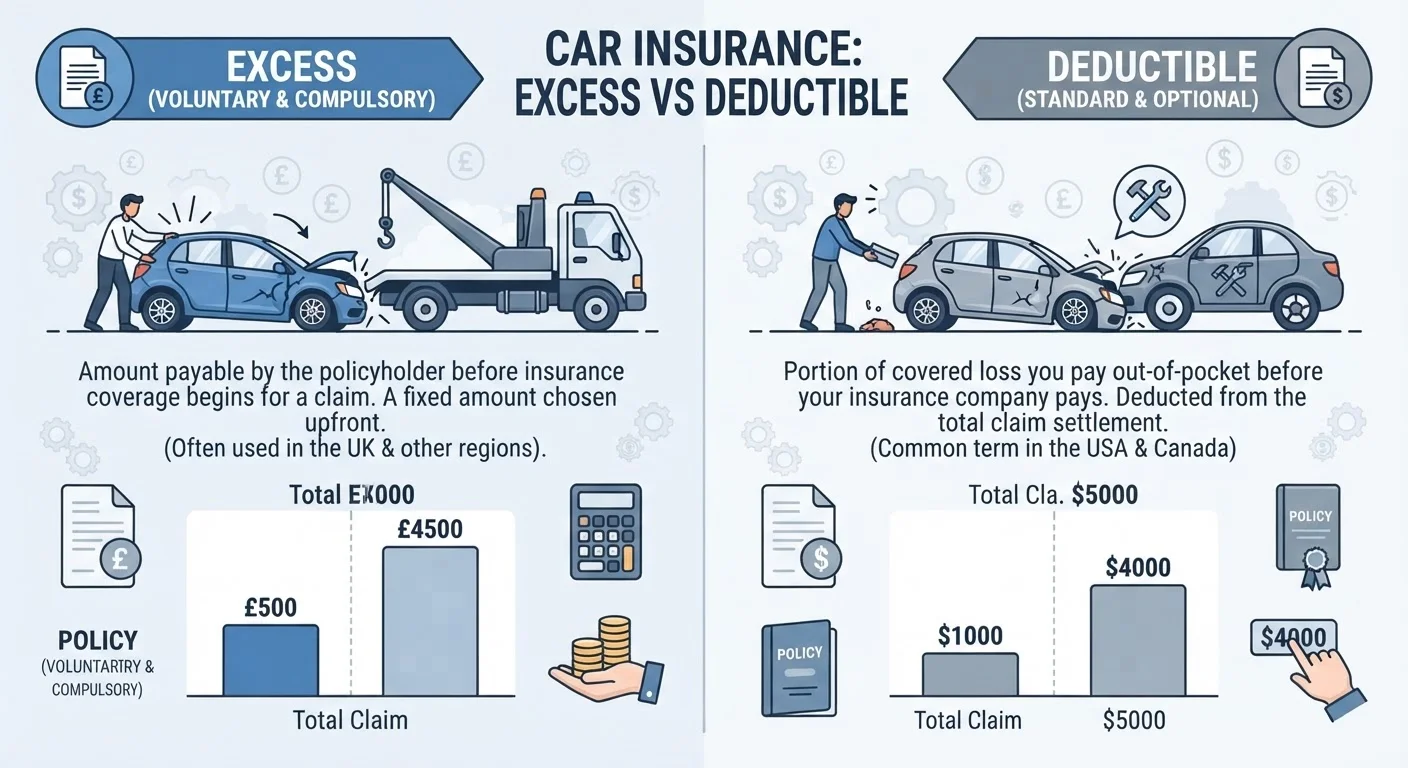
Photo: InsightsVault.com | Interesting Daily Reads editorial
Same Idea, Different Labels
Excess and deductible refer to the same fundamental mechanic in car insurance: the portion of a claim you pay out of pocket before your insurer covers the rest. The terminology you encounter depends mainly on geography. In the United States, deductible is standard. In the United Kingdom, Australia, and much of the Commonwealth, excess is the preferred term. On international or multi-market insurance comparison sites, you may see both used interchangeably, which can cause genuine confusion.
The practical meaning is identical: if you file a collision claim and your deductible (or excess) is $500, and the repair costs $3,000, your insurer pays $2,500 and you pay $500. Understanding this single concept - regardless of what it's called - is central to evaluating any auto policy. See also our guide on choosing the right level of cover for how this interacts with your coverage tier.
| US term | Deductible |
| UK/Australian term | Excess |
| Common US collision deductible range | $250-$2,000 (General industry range; varies by insurer and state) |
| Applies to | Collision and comprehensive coverages (not liability) |
| Effect of raising deductible | Lower premium, higher out-of-pocket cost per claim |
| Liability coverage deductible | None - liability pays third parties, not you |
Compulsory vs. Voluntary: The Two Layers
Most car insurance policies - especially outside the US - split this cost-sharing requirement into two parts:
- Compulsory excess (mandatory deductible): Set by the insurer. You cannot negotiate it away. It typically reflects the insurer's assessment of risk factors like your vehicle type, age, or claims history.
- Voluntary excess (chosen deductible): An additional amount you elect to pay on top of the compulsory portion, usually in exchange for a lower premium.
In the US market, most personal auto policies present a single deductible figure per coverage type - commonly collision and comprehensive - which you choose when you set up the policy. There is no formal "compulsory" layer in most US states, though minimum liability coverage requirements exist separately and work differently (they pay other parties, not you).
Watch Out for Excess on Add-Ons
Raising a voluntary excess or selecting a higher deductible lowers your regular premium - but it increases your financial exposure each time you file a claim. Whether that trade-off works in your favor depends on your emergency fund, driving habits, and local repair costs. This is general information; consult a licensed insurance agent for advice tailored to your situation.
How Deductible Levels Affect Your Real Costs
Choosing a deductible is essentially a bet about frequency and cost of claims. A higher deductible reduces what you pay each month or year in premiums, but commits you to a larger out-of-pocket payment if something goes wrong. A lower deductible does the reverse.
A few practical reference points worth knowing:
- Common US collision deductible options range from $250 to $2,000. The premium difference between a $500 and $1,000 deductible varies by insurer and driver profile but can be meaningful over several years.
- If you drive infrequently or have a strong emergency fund, a higher deductible may be financially rational - you absorb small losses and save on premiums over time.
- If your vehicle's market value is low, a very high deductible can leave you in a situation where a collision payout barely covers the cost or isn't worth claiming at all.
Because excess and deductible amounts are a fixed cost you'd need to cover quickly after an incident, they function as a semi-predictable variable expense within your budget. Our overview of fixed vs. variable expenses explains how to account for this kind of conditional cost in your monthly plan.
When comparing policies, always look at the full picture - not just the premium. Our checklist for comparing car insurers walks through how to put two policies on equal footing before switching. You may also want to review car insurance add-ons worth understanding since some add-ons affect whether an excess applies to specific claim types.
This article is for general informational purposes only and does not constitute personalised insurance, financial, or legal advice. Coverage terms, excess amounts, and regulations vary by insurer and state. Always read your policy documents carefully and consult a licensed insurance professional for guidance specific to your situation.
The content provided on our blog site traverses numerous categories, offering readers valuable and practical information. Readers can use the editorial team’s research and data to gain more insights into their topics of interest. However, they are requested not to treat the articles as conclusive. The website team cannot be held responsible for differences in data or inaccuracies found across other platforms. Please also note that the site might also miss out on various schemes and offers available that the readers may find more beneficial than the ones we cover.