
Reading a Pet Food Nutrition Label: A Field Guide

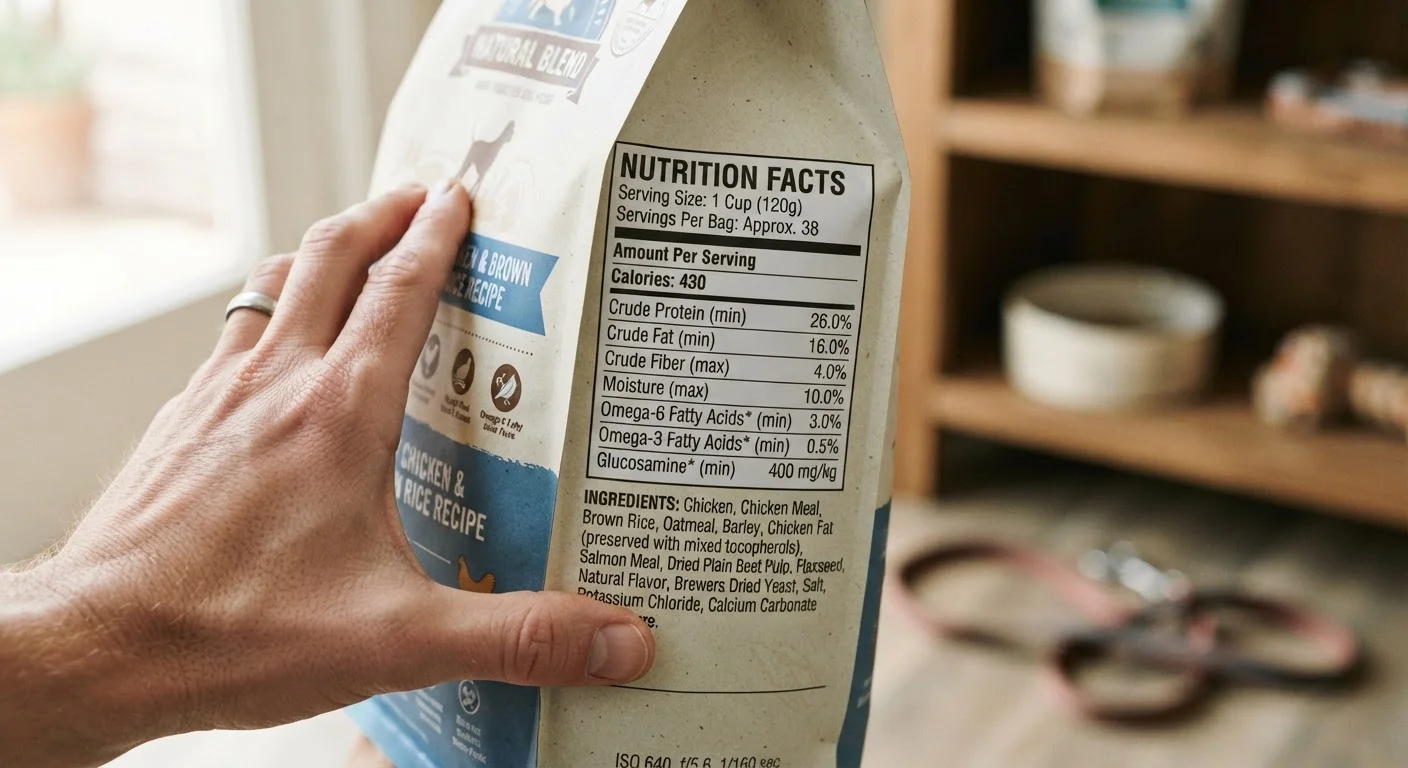
Photo: InsightsVault.com | Interesting Daily Reads editorial
The Five Sections Every Pet Food Label Must Include
U.S. pet food labels are regulated by the AAFCO and, in most states, enforced at the state level. While packaging design varies widely, every label sold legally in the U.S. must carry five core elements: the product name, the net weight or volume, the manufacturer's name and address, the ingredient list, and the guaranteed analysis. Understanding what each section actually communicates - and what it doesn't - is the foundation of smarter food shopping for your pet.
| Required label elements (U.S.) | 5: product name, net weight, manufacturer info, ingredient list, guaranteed analysis (AAFCO model regulations) |
| Typical wet food moisture content | 75-82% (General industry range) |
| Typical dry kibble moisture content | ~10% (General industry range) |
| Guaranteed analysis minimums reported | Crude protein and crude fat (AAFCO model regulations) |
| Guaranteed analysis maximums reported | Crude fiber and moisture (AAFCO model regulations) |
| AAFCO life stages recognized | Growth, adult maintenance, reproduction, all life stages (AAFCO nutrient profiles) |
For a broader look at how to build food costs into your overall pet care budget, see our pet health budgeting guide.
Ingredient List: Order Matters, But Not Everything
Ingredients are listed in descending order by pre-cooking weight. A named animal protein (such as chicken or salmon) appearing first generally indicates it was the heaviest single ingredient before processing. However, dry ingredients like grain meals are denser after moisture removal, so a meal listed third may outweigh a fresh protein listed first on an as-fed basis. This is called ingredient splitting when manufacturers break one ingredient (e.g., corn) into multiple forms to push it lower on the list.
What to look for: a named protein source in the first two or three positions, and a short list of recognizable components. Long lists of chemical-sounding additives near the top warrant a closer read. Our article on generic vs. name-brand pet food labels breaks down exactly how ingredient lists differ across price tiers.
Guaranteed Analysis
A panel on pet food labels showing minimum or maximum percentages of crude protein, crude fat, crude fiber, and moisture. These are regulatory guarantees, not exact nutrient measurements.
Dry Matter Basis
A method of comparing nutrient content between foods with different moisture levels by removing water from the calculation. Essential for comparing wet and dry pet foods accurately.
AAFCO
The Association of American Feed Control Officials - the organization that establishes model regulations and nutrient profiles used as the basis for most U.S. pet food labeling standards.
Ingredient Splitting
A labeling practice where a single ingredient is listed in multiple forms (e.g., corn flour, corn gluten, ground corn) to reduce its apparent prominence on the ingredient list.
Nutritional Adequacy Statement
A required label statement indicating whether a pet food is complete and balanced for a specific life stage, and whether that claim is based on nutrient profiling or an actual feeding trial.
Crude Protein
A measure of total nitrogen-containing compounds in a food, used to estimate protein content. It does not distinguish between highly digestible and poorly digestible protein sources.
Guaranteed Analysis: Four Numbers and What They Mean
The guaranteed analysis panel reports minimum or maximum percentages for four nutrients: crude protein (minimum), crude fat (minimum), crude fiber (maximum), and moisture (maximum). These are guarantees, not exact measurements - actual levels can be higher for minimums or lower for maximums.
One critical caveat: you cannot directly compare a wet food's guaranteed analysis to a dry food's because wet food contains far more water (often 75-82% moisture vs. 10% for kibble). To compare accurately, convert both to a dry matter basis by dividing the nutrient percentage by the percentage of dry matter (100 minus moisture %). For example, a wet food showing 8% crude protein with 78% moisture has a dry matter protein of roughly 36% - much closer to many dry foods than the label suggests.
These numbers are useful for identifying foods that are unusually low in protein or high in fiber for your pet's species and life stage, but they don't tell you about amino acid profiles, digestibility, or ingredient quality. See our dry food vs. wet food cost trade-offs article for how moisture content affects per-serving cost comparisons.
The AAFCO Nutritional Adequacy Statement
This small block of text may be the most important sentence on the label. It states whether the food is formulated to meet AAFCO nutrient profiles for a specific life stage (growth, adult maintenance, reproduction, or all life stages), or whether it passed an AAFCO feeding trial. Look for language like: "formulated to meet the nutritional levels established by the AAFCO Dog Food Nutrient Profiles for adult maintenance."
A food without any AAFCO statement is not considered complete and balanced - it may be a treat, a topper, or a supplemental food. Feeding it as a sole diet can lead to nutritional deficiencies over time. If a label reads "for intermittent or supplemental feeding only," it should not be your pet's primary food source. Budget-conscious shoppers sometimes buy these products thinking they are getting a bargain on a full meal; they are not.
Life stage also matters practically: a food labeled for "all life stages" meets the more demanding growth standards and is nutritionally appropriate for puppies or kittens, but may supply more calories and certain nutrients than a senior or less active adult needs.
This article provides general educational information about pet food labeling. It is not a substitute for veterinary nutrition advice. Consult your veterinarian for guidance tailored to your specific pet's health needs.
The content provided on our blog site traverses numerous categories, offering readers valuable and practical information. Readers can use the editorial team’s research and data to gain more insights into their topics of interest. However, they are requested not to treat the articles as conclusive. The website team cannot be held responsible for differences in data or inaccuracies found across other platforms. Please also note that the site might also miss out on various schemes and offers available that the readers may find more beneficial than the ones we cover.