
Generic vs. Name-Brand Pet Food: What the Labels Actually Tell You

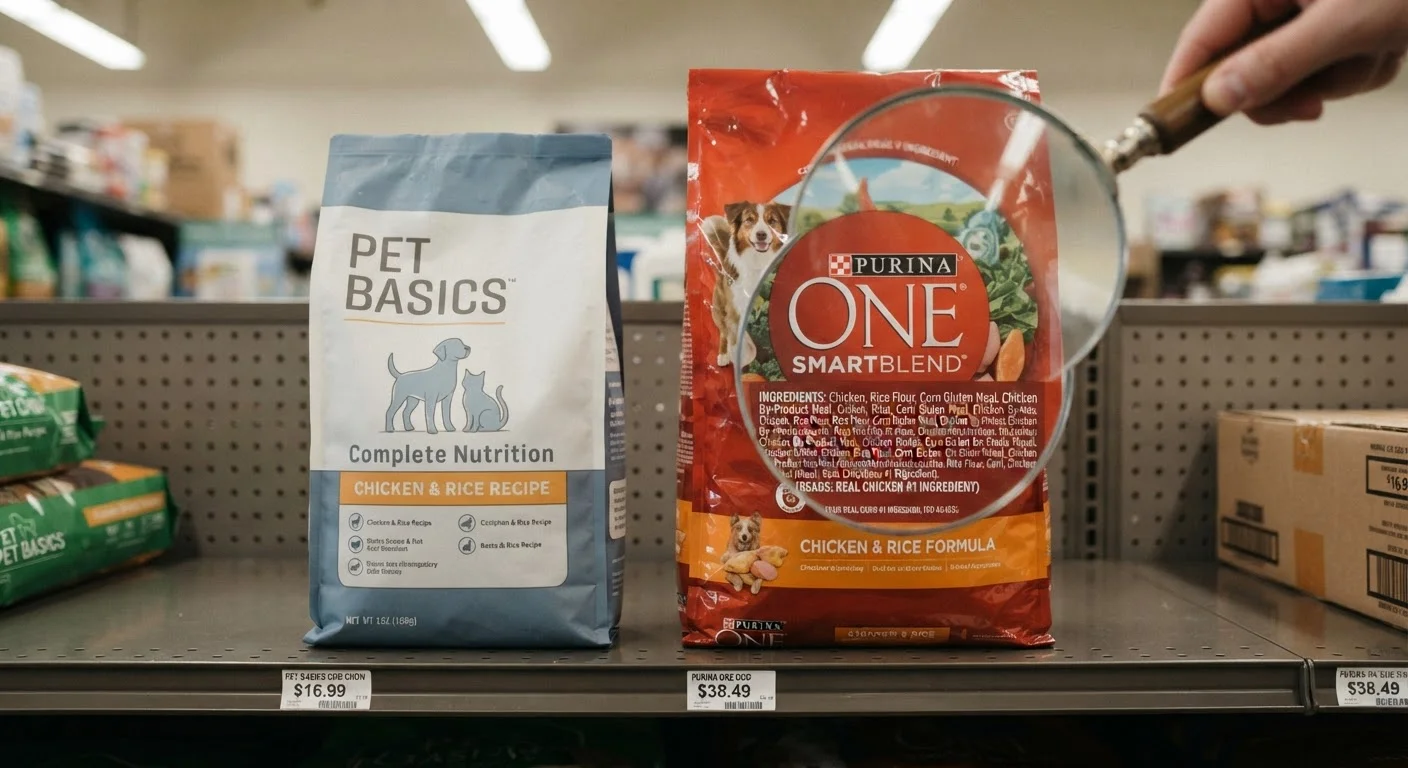
Photo: InsightsVault.com | Interesting Daily Reads editorial
Key Takeaways
- Ingredient lists are ordered by pre-cooking weight, which affects how you interpret meat versus meat meal listings.
- The AAFCO nutritional adequacy statement is the single most important sentence on any pet food label.
- Generic and store-brand foods must meet the same AAFCO standards as premium name brands.
- Price per serving, not price per bag, is the correct way to compare food costs across products.
- Marketing terms like 'holistic,' 'natural,' and 'premium' have no regulated definition in pet food.
Why the Label - Not the Logo - Is What Matters
Marketing budgets, attractive packaging, and celebrity endorsements have very little to do with what's actually inside a bag of pet food. The regulated sections of the label - ingredient list, guaranteed analysis, and AAFCO statement - are where the meaningful information lives, and they follow the same rules for a $12 store-brand kibble as for a $65 boutique bag.
The persistent assumption that a higher price signals better nutrition is understandable but often unsupported. Name brands invest heavily in advertising, retail placement fees, and brand equity - costs that show up in the price without improving the food's nutritional profile. That doesn't mean expensive foods are bad; it means price alone is an unreliable proxy for quality. Reading a pet food nutrition label in full detail is the skill that actually lets you judge any product fairly.
Unregulated Marketing Terms to Ignore
Decoding the Ingredient List
Ingredients are listed in descending order by pre-cooking weight. This matters because whole meats - chicken, beef, salmon - contain significant moisture, so they weigh more before processing than after. A food listing 'chicken' first may actually deliver less protein per serving than one listing 'chicken meal,' which is already rendered and concentrated.
Look at the first five to seven ingredients collectively. A food leading with a named protein source (chicken, turkey, lamb) or a named meal (chicken meal, salmon meal) followed by digestible carbohydrates and fats is generally well-structured. Unnamed ingredients - 'meat and bone meal,' 'poultry by-product meal' - indicate lower-grade or less consistent sourcing, though by-products are not inherently harmful and can include nutrient-rich organ meats.
Ingredient splitting is a tactic worth knowing: manufacturers sometimes divide a single ingredient - say, corn - into multiple forms (ground corn, corn gluten meal, corn flour) that each appear lower on the list individually, making the food look more protein-forward than it is. Scan for repetition of the same base ingredient in different forms.
Calculate Cost Per Day, Not Per Bag
The AAFCO Statement: The Single Most Important Line
Every pet food sold as a complete diet must carry an AAFCO nutritional adequacy statement. It will say something like: ' is formulated to meet the nutritional levels established by the AAFCO Dog Food Nutrient Profiles for adult maintenance.'
This statement tells you two critical things: whether the food is complete and balanced (versus supplemental only), and which life stage it covers. 'All life stages' is the most inclusive designation and meets the highest nutrient thresholds, including those needed for growth and reproduction. 'Adult maintenance' covers healthy adults but may not support puppies or kittens adequately.
Foods without this statement - or those marked 'for intermittent or supplemental feeding only' - are not designed to be sole-diet foods. This applies regardless of price point. A generic food carrying a complete AAFCO statement is nutritionally more appropriate as a daily diet than a name-brand food without one. See our breakdown of dry, wet, and raw diet trade-offs for how format interacts with these considerations.
Guaranteed Analysis and What the Numbers Mean
The guaranteed analysis panel lists minimum percentages of crude protein and crude fat, and maximum percentages of crude fiber and moisture. These are regulatory minimums and maximums - not precise averages - so treat them as directional rather than exact.
To compare foods with different moisture levels (dry versus wet, for example), you need to convert to a dry-matter basis. Subtract the moisture percentage from 100 to get the dry-matter percentage, then divide the nutrient percentage by that number. This allows apples-to-apples comparison between a 10% moisture kibble and a 78% moisture canned food.
95%+
U.S. states adopting AAFCO model regulations
AAFCO reports that the vast majority of U.S. states have adopted its model regulations, meaning the same labeling standards apply to generic and name-brand foods across the country.
~30%
Typical moisture content difference: dry vs. wet food
Standard dry kibble contains roughly 6-10% moisture while wet canned food typically contains 75-82%, making direct nutrient comparison impossible without a dry-matter conversion.
2
Methods allowed to substantiate an AAFCO adequacy claim
AAFCO allows manufacturers to substantiate a complete-and-balanced claim either through nutrient-profile formulation or through actual animal feeding trials - and the label must disclose which method was used.
The guaranteed analysis doesn't tell you about ingredient digestibility - how much of that protein your pet actually absorbs. Higher digestibility generally means smaller stool volume and better utilization of nutrients, though this data isn't required on labels. This is one area where established brands sometimes invest in feeding trials, which is worth weighing if your pet has specific health needs. Consult your veterinarian for guidance tailored to your individual animal.
What Generic Labels Can and Can't Tell You
Store-brand and generic pet foods sold through major retailers must comply with the same federal and state regulations as name brands. An AAFCO complete-and-balanced claim on a store-brand label carries identical regulatory weight to the same claim on a premium package. The gap, when it exists, is typically in ingredient sourcing consistency, palatability, and whether the formula undergoes feeding trials versus computer-modeled formulation only.
Feeding trials - where the food is fed to actual animals and outcomes are measured - are the gold standard for validating a formula. Formulation alone means the recipe meets AAFCO nutrient profiles on paper. Many generics use formulation; some name brands do too. The label will indicate which approach was used: look for language like 'animal feeding tests using AAFCO procedures' versus 'formulated to meet.'
For healthy adult pets with no special dietary needs, a generic or store-brand food meeting AAFCO standards can be a perfectly sound choice. For pets with health conditions, life-stage needs, or a history of food sensitivities, the calculus shifts - and a veterinary conversation is the right starting point, not a label comparison alone. The same generic-versus-brand logic applies to pet medications, where regulation plays an equally important role.
For further reading on how to apply these label-reading skills to your own grocery shopping, our guide to decoding nutrition labels for budget shoppers covers the parallel human food landscape.
This article provides general educational information about pet food labeling and is not a substitute for individualized veterinary advice. Always consult a licensed veterinarian regarding your specific pet's dietary needs.
Frequently Asked Questions
The content provided on our blog site traverses numerous categories, offering readers valuable and practical information. Readers can use the editorial team’s research and data to gain more insights into their topics of interest. However, they are requested not to treat the articles as conclusive. The website team cannot be held responsible for differences in data or inaccuracies found across other platforms. Please also note that the site might also miss out on various schemes and offers available that the readers may find more beneficial than the ones we cover.