
Couponing Across Categories: Adapting Your Approach for Groceries, Travel, and Services

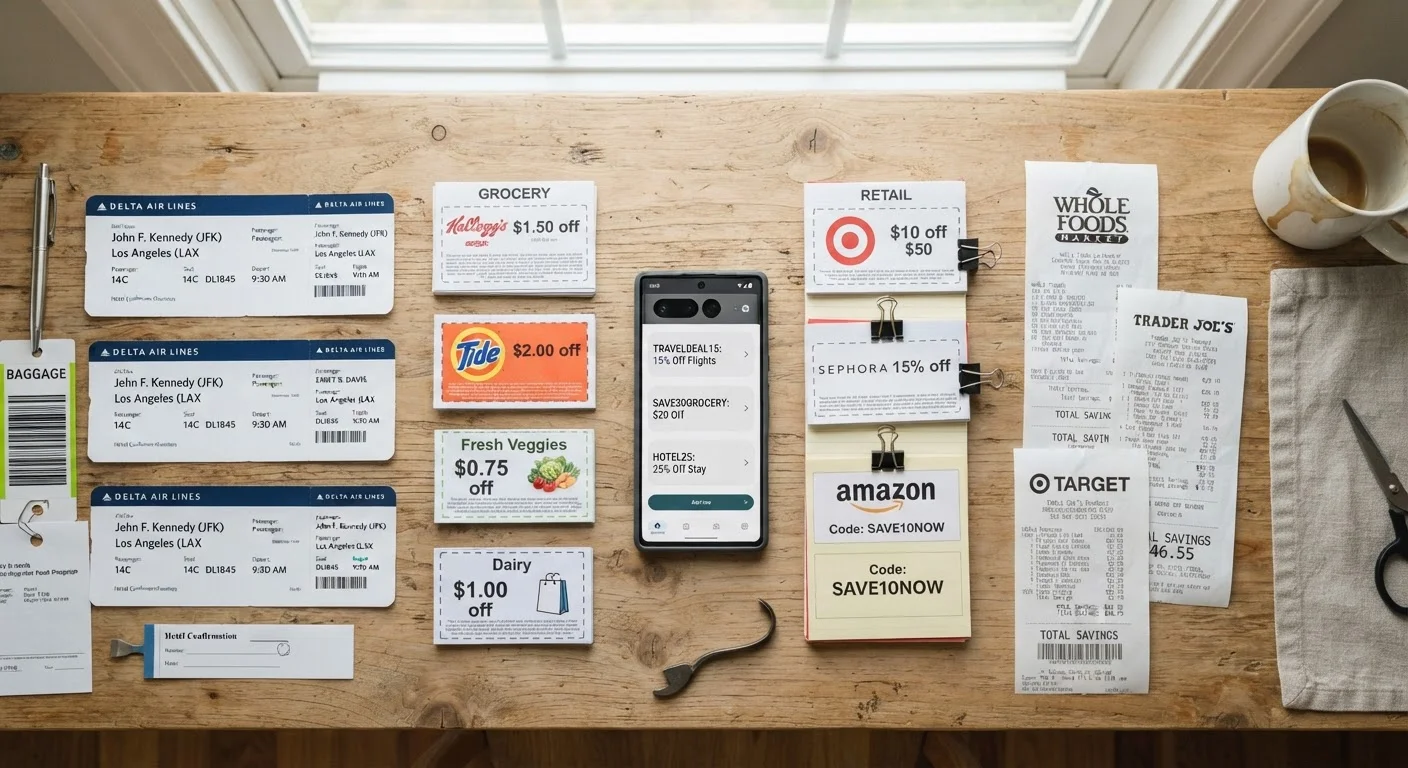
Photo: InsightsVault.com | Interesting Daily Reads editorial
Key Takeaways
- Grocery couponing relies on stacking manufacturer and store coupons with sale cycles for maximum savings.
- Travel discounts are time-sensitive and category-specific - airline, hotel, and car rental codes rarely overlap.
- Service discounts often hide in loyalty programs, referral bonuses, and first-time subscriber offers.
- Cashback apps and browser extensions can complement coupons across multiple shopping categories.
- Understanding each category's discount structure helps you avoid wasted effort and expired codes.
Why One-Size-Fits-All Couponing Falls Short
Most people learn couponing through groceries - clip a coupon, match it to a sale, save a few dollars. That logic is sound for the supermarket, but it breaks down fast when you try to apply it to a flight booking or a home cleaning service. Each shopping category has its own discount ecosystem, its own timing rules, and its own stacking limits.
The result: consumers who are sharp grocery savers often leave money on the table in travel and services because they're using the wrong playbook. Understanding how discount structures differ by category is the foundation of smarter spending across the board. For a broader look at pulling together everything from coupon sources to seasonal timing, the complete guide to finding and using coupons throughout the year covers the full picture.
Groceries: Stack Systematically, Not Spontaneously
Grocery couponing has the most mature stacking structure of any category. Most major supermarket chains allow one manufacturer coupon combined with one store coupon on a single item - apply that during a sale week and you've layered three separate discounts. The discipline here is timing: matching your coupons to the store's weekly circular cycle rather than shopping when it's convenient.
Digital coupons clipped to loyalty accounts are now the dominant format at most chains, and they load automatically at checkout - no paper required. Pair these with a cashback app submission on the same receipt, and you've added a fourth savings layer. Using cashback apps alongside coupons without doubling your workload is more straightforward than it sounds once you build a routine.
Key discipline: resist buying items just because you have a coupon. A discount on something you wouldn't otherwise purchase isn't savings - it's spending.
Matching coupons to sale weeks, not shopping convenience, is where grocery savings compound.
Travel: Work the Booking Window and Loyalty Layers
Travel discounts operate on time and category rather than stacking in the traditional sense. Airlines, hotels, and car rental companies each have distinct pricing algorithms, and promo codes are usually category-exclusive - a hotel discount code won't apply to a rental car booked on the same platform, even through a travel aggregator.
The most reliable discount lever in travel is the booking window. Domestic flights often see price dips around six to eight weeks before departure, while hotels can be negotiated closer to arrival dates when rooms go unsold. Loyalty programs add a separate layer: points, member rates, and status upgrades function as ongoing discounts that compound over time in ways a one-time code cannot.
For travelers who plan to supplement paid meals with local grocery runs, grocery shopping while travelling is a practical way to stretch the budget further without sacrificing quality. Always verify current entry requirements, airline policies, and hotel terms directly with providers before booking.
In travel, the booking window is often the most powerful discount lever available to you.
Services: Time Your Ask and Know the Offer Types
Service discounts - for subscriptions, home services, insurance, and professional services - rarely appear in coupon databases the way grocery deals do. Instead, they surface in three predictable places: new-customer promotions, referral programs, and retention offers triggered when you contact a provider to cancel or negotiate.
New-subscriber discounts are the most widely available. Streaming platforms, software subscriptions, and home service providers routinely offer introductory rates to first-time customers. The catch is that these rates expire, and providers count on the friction of canceling to keep customers paying full price. Set a calendar reminder before the promotional period ends.
Retention offers are underused. Calling or chatting with a provider's customer service team before canceling a service - internet, insurance, gym memberships - frequently surfaces discounts or credits that aren't advertised. This approach requires a few minutes of effort but has a high success rate for recurring services where customer acquisition costs are high.
Retention offers on services are rarely advertised - but asking at the right moment often works.
Online Retail: Let Automation Do the Heavy Lifting
For general online retail - apparel, electronics, household goods - the discount landscape has shifted toward automation. Browser extensions that test promo codes at checkout have become a practical baseline tool, removing the need to manually search for codes before each purchase. Browser extensions for automatic coupons vary in how they source codes and what data they collect, so it's worth understanding how each tool works before installing.
Abandoned-cart discounts are another pattern worth knowing: many retailers will email a discount code within 24 hours if you add items to a cart and leave without purchasing. This only works once per email address and retailer, but it's a legitimate way to capture a discount on a planned purchase.
For anything with complex pricing - format bundles, subscription tiers, size-based unit pricing - comparing value across different product formats helps ensure the discounted option is actually the better deal.
Abandoned-cart emails from retailers often deliver a discount code within 24 hours - useful for planned purchases.
Pharmacies and Health-Adjacent Shopping: Stack with Caution
Pharmacy chains operate some of the most complex loyalty and coupon stacking environments outside of grocery stores - rewards points, store coupons, manufacturer coupons, and cashback offers can theoretically all apply to a single transaction. However, the rules vary significantly between chains and can change with little notice, so it's worth verifying current stacking policies before building a strategy around them.
For non-prescription items - personal care, vitamins, household products - the grocery couponing approach (manufacturer plus store coupon plus sale) often applies directly when shopping at a pharmacy retailer. For prescription medications, discount programs exist separately from standard coupons; your pharmacist is the appropriate resource for navigating those options.
Understanding when coupons are declined is as important as knowing how to use them. Why that coupon didn't work explains the most common causes and how to troubleshoot them before your next visit.
This article is for general informational purposes only. Consult a licensed pharmacist or healthcare professional for guidance on prescription costs or medication decisions.
Pharmacy stacking rules vary by chain - verify current policies before relying on a multi-layer discount plan.
Putting It All Together
The common thread across every category is intentionality. Discounts don't disappear - they just live in different places and operate under different rules depending on what you're buying. Grocery savings come from systematic stacking and timing; travel savings from booking windows and loyalty status; service savings from negotiating at the right moment or knowing where first-time offers are published.
Expanding your approach category by category - rather than hunting for a universal hack - is what separates occasional savers from consistent ones. And if you frequently shop across both online and in-store channels, blending online and in-store shopping strategically can sharpen your discount-finding even further.
Track Your Discount Sources by Category
The content provided on our blog site traverses numerous categories, offering readers valuable and practical information. Readers can use the editorial team’s research and data to gain more insights into their topics of interest. However, they are requested not to treat the articles as conclusive. The website team cannot be held responsible for differences in data or inaccuracies found across other platforms. Please also note that the site might also miss out on various schemes and offers available that the readers may find more beneficial than the ones we cover.