
How Retailers Use Anchoring to Shape What Feels Like a Fair Price

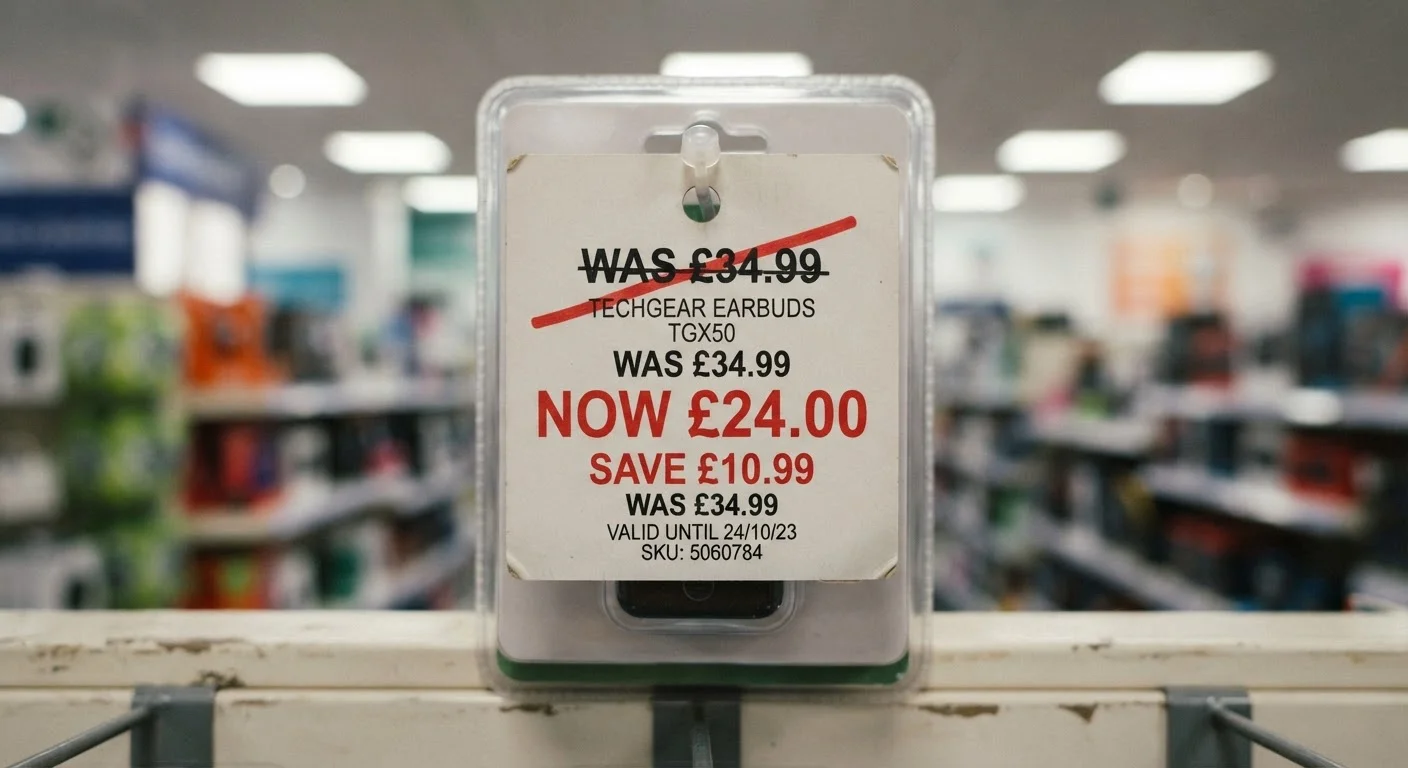
Photo: InsightsVault.com | Interesting Daily Reads editorial
Key Takeaways
- The crossed-out 'original' price on a sale tag is designed to set your reference point, not necessarily reflect what the item ever sold for.
- Anchoring works even when shoppers know it's happening - awareness alone doesn't eliminate the bias.
- Comparing a price to an external reference (e.g., a competitor or unit price) neutralizes anchoring more effectively than willpower.
- High-low pricing, MSRP displays, and premium decoy items are all anchoring tools commonly used in retail.
- The antidote is asking what you'd pay if you saw only the sale price - with no crossed-out number beside it.
Why That Crossed-Out Number Exists
Walk through any retail store or browse almost any e-commerce site, and you'll see it constantly: a price with a line through it, sitting next to a lower number in bold. The crossed-out figure is called an anchor. Its entire purpose is to give your brain a starting point - a reference that makes everything measured against it feel like a relative gain or loss.
Retailers didn't stumble onto this by accident. Decades of consumer psychology research confirm that people don't evaluate prices in isolation. They evaluate them relative to something. Set the reference point high, and the selling price feels like a win. Remove the reference entirely, and shoppers have to form their own judgment - which is far less predictable for the seller.
The anchor doesn't have to be real to be effective. A manufacturer's suggested retail price (MSRP) that was never the actual street price, a briefly inflated 'was' price that appeared for a few days before a markdown, or a premium product placed beside a mid-range one - all of these function as anchors. They shift your internal number line before you've made any conscious decision.
Awareness Helps, But Isn't Enough
The Common Forms Anchoring Takes in Retail
Anchoring isn't limited to crossed-out price tags. Once you know what to look for, the pattern shows up across the entire shopping environment:
- High-low pricing: Retailers set an inflated 'regular' price, then discount frequently, so the sale price feels like the reward for shopping at the right time.
- MSRP displays: Showing the manufacturer's suggested price alongside a lower shelf price implies savings without guaranteeing the MSRP was ever the real market price.
- Decoy products: A premium version of a product placed near the standard version makes the standard seem affordable by comparison, even if the standard is still expensive relative to alternatives.
- Bundle anchoring: Showing the combined individual item prices before presenting a bundle price frames the bundle as a bargain, regardless of whether the bundled items are ones you'd have bought anyway.
Online shopping adds another layer. Dynamic pricing means the 'original' price a strikethrough references may have existed for only hours. Online deals can obscure true costs in ways that mirror - and sometimes amplify - in-store anchoring tactics.
~60%
Shoppers influenced by reference prices
Consumer behavior research consistently finds that a majority of shoppers adjust their willingness to pay based on the first price shown, even when told it may be arbitrary.
2-3x
Typical high-low pricing markup ratio
Industry pricing analysts have observed that high-low retail formats commonly set 'regular' prices at two to three times the anticipated sale price to maximize perceived discount depth.
How to Neutralize the Anchor Effect
The most effective counter-strategy is to replace the retailer's anchor with your own. Before you shop, decide what you'd consider a fair price for an item - without looking at any marketing. Then use external references to test that figure:
- Check unit pricing. For groceries and household goods, the cost-per-unit figure (often on the shelf label) lets you compare products by actual value rather than by sticker price. Unit pricing is one of the most underused tools in retail shopping.
- Use price-history tools. Browser extensions that track historical prices on major retail sites let you see whether a 'sale' price is genuinely lower than the item's typical selling price.
- Search the market independently. Look at what comparable items - not just the same item - cost elsewhere. A crossed-out $120 next to $79 means little if equivalent products sell for $65 routinely.
- Ask the anchor-free question: Cover up the original price and ask whether you'd consider the sale price fair if that were the only number visible. If the answer is no, the anchor was doing all the work.
As a general principle, treat 'sale' as a display - not a guarantee of value. The discount is relative to the anchor; your decision should be relative to the market.
Set Your Own Anchor Before You Shop
Frequently Asked Questions
The content provided on our blog site traverses numerous categories, offering readers valuable and practical information. Readers can use the editorial team’s research and data to gain more insights into their topics of interest. However, they are requested not to treat the articles as conclusive. The website team cannot be held responsible for differences in data or inaccuracies found across other platforms. Please also note that the site might also miss out on various schemes and offers available that the readers may find more beneficial than the ones we cover.