
Roof Ventilation and Attic Insulation: Weighing the Trade-offs

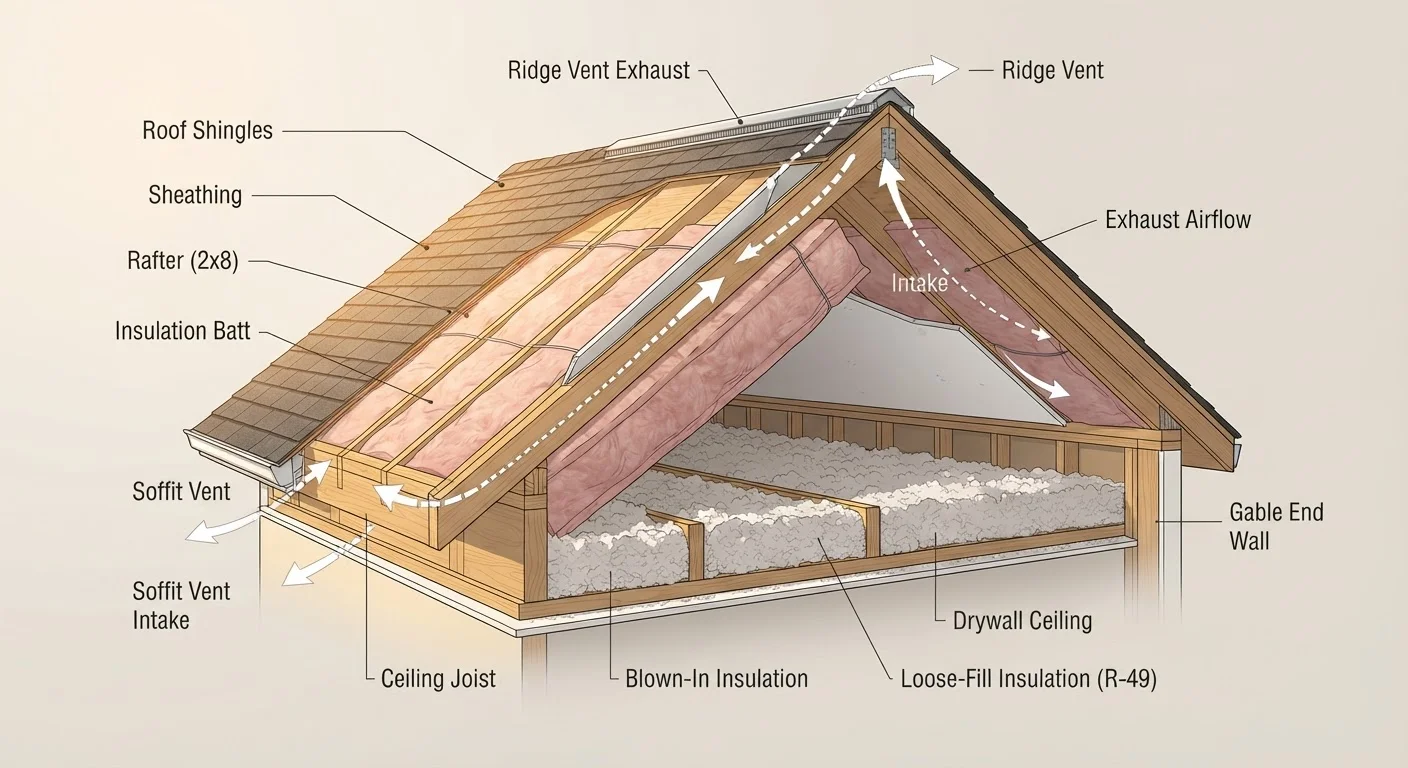
Photo: InsightsVault.com | Interesting Daily Reads editorial
Key Takeaways
- Attic insulation and roof ventilation work as a system - upgrading one without the other can undermine results.
- Adding insulation can reduce heating and cooling energy use, but payback periods vary significantly by climate and existing conditions.
- Insufficient ventilation can cause moisture damage, ice dams, and premature roof deterioration.
- DIY insulation additions are feasible for many homeowners; ventilation work often requires a licensed contractor.
- Federal and state tax credits may offset upgrade costs - verify current eligibility before committing.
Reduces heating and cooling energy demand
Bringing attic insulation up to recommended R-values (R-38 to R-60 in most U.S. climate zones) can reduce the thermal load on your HVAC system, though actual savings vary by home and climate.
Improves year-round comfort
Adequate insulation reduces temperature swings in rooms directly below the attic, making upper floors more comfortable in both summer and winter.
Relatively accessible for DIY installation
Blown-in cellulose and fiberglass batt insulation are commonly available at home improvement stores, and adding depth to an existing attic floor is a manageable project for physically able homeowners.
May qualify for federal tax credits
Current federal energy efficiency incentives may cover a percentage of insulation upgrade costs; consult a tax professional to confirm eligibility for your situation.
Diminishing returns above a threshold R-value
Each additional inch of insulation delivers less marginal benefit than the last. Going from R-11 to R-30 saves far more than going from R-38 to R-60, so overspending on depth provides poor payback.
Air sealing must come first for full effectiveness
Insulation without air sealing allows humid air to bypass the thermal barrier, reducing efficiency and potentially trapping moisture inside wall and ceiling assemblies.
Attic access and working conditions can be challenging
Low-clearance attics with irregular framing, existing obstructions, or older hazardous materials (such as vermiculite, which may contain asbestos) require professional assessment before any work begins.
Payback period varies widely by climate and energy costs
In mild climates with moderate energy prices, payback on a full insulation upgrade can stretch beyond a decade, making it a long-term investment rather than a quick savings fix.
How Attic Insulation and Roof Ventilation Interact
Attic insulation and roof ventilation are often discussed separately, but they function as a single thermal system. Insulation slows heat transfer between your living space and the attic; ventilation removes heat and moisture that accumulate in the attic regardless. When one is out of balance, the other can't do its job well.
A heavily insulated attic with poor airflow traps moisture, which degrades insulation performance and can rot structural framing. Conversely, excellent ventilation in an under-insulated attic moves a lot of conditioned air that you've already paid to heat or cool. Understanding this relationship is the starting point for any worthwhile upgrade.
For broader context on where attic improvements fit in a whole-home efficiency plan, see the year-round home energy savings roadmap.
Pros of Upgrading Attic Insulation
Adding insulation to an under-insulated attic is one of the highest-return energy upgrades available to most homeowners. The U.S. Department of Energy estimates that properly insulating an attic in a climate-appropriate R-value range can reduce heating and cooling costs noticeably - though actual savings depend heavily on your starting point and local energy prices.
Reduces heating and cooling energy demand
Bringing attic insulation up to recommended R-values (R-38 to R-60 in most U.S. climate zones) can reduce the thermal load on your HVAC system, though actual savings vary by home and climate.
Improves year-round comfort
Adequate insulation reduces temperature swings in rooms directly below the attic, making upper floors more comfortable in both summer and winter.
Relatively accessible for DIY installation
Blown-in cellulose and fiberglass batt insulation are commonly available at home improvement stores, and adding depth to an existing attic floor is a manageable project for physically able homeowners.
May qualify for federal tax credits
Current federal energy efficiency incentives may cover a percentage of insulation upgrade costs; consult a tax professional to confirm eligibility for your situation.
Many attics built before the 1980s fall well below modern recommended R-values. If your attic has less than R-30, adding insulation is almost always worth evaluating. It's also one of the more accessible DIY home repairs - blown-in cellulose or fiberglass batts are manageable for homeowners comfortable working in attic conditions.
Cons of Attic Insulation Upgrades
Insulation upgrades aren't straightforward in every home. Several factors can reduce effectiveness or increase cost in ways that aren't obvious upfront.
Diminishing returns above a threshold R-value
Each additional inch of insulation delivers less marginal benefit than the last. Going from R-11 to R-30 saves far more than going from R-38 to R-60, so overspending on depth provides poor payback.
Air sealing must come first for full effectiveness
Insulation without air sealing allows humid air to bypass the thermal barrier, reducing efficiency and potentially trapping moisture inside wall and ceiling assemblies.
Attic access and working conditions can be challenging
Low-clearance attics with irregular framing, existing obstructions, or older hazardous materials (such as vermiculite, which may contain asbestos) require professional assessment before any work begins.
Payback period varies widely by climate and energy costs
In mild climates with moderate energy prices, payback on a full insulation upgrade can stretch beyond a decade, making it a long-term investment rather than a quick savings fix.
One overlooked issue: adding insulation without first air-sealing gaps around plumbing penetrations, recessed lights, and framing can actually increase moisture problems by slowing drying while still allowing humid air to infiltrate. The air sealing vs. insulation comparison explains why sequencing matters and which step typically delivers more impact per dollar.
Pros and Cons of Roof Ventilation Improvements
Roof ventilation - typically a combination of soffit intake vents and ridge or gable exhaust vents - regulates attic temperature and humidity year-round. In summer, it expels superheated air that would otherwise radiate down into living spaces. In winter, it prevents warm moist air from condensing on cold roof sheathing.
1:150
Minimum ventilation ratio (vent area to attic floor)
The U.S. Federal Housing Administration and most building codes specify at least 1 sq ft of net free vent area per 150 sq ft of attic floor when intake and exhaust are not balanced.
R-38 to R-60
Recommended attic insulation range for most U.S. climates
The U.S. Department of Energy's zone-based recommendations place most of the continental U.S. in the R-38 to R-60 range for attic floors, depending on heating and cooling needs.
Ventilation improvements can meaningfully extend shingle life and reduce ice-dam risk in cold climates. However, adding ventilation to an already well-ventilated attic produces diminishing returns. The standard ventilation ratio (1 square foot of net free vent area per 150 square feet of attic floor, or 1:300 with balanced intake and exhaust) is a reasonable benchmark, but roof geometry and local climate can shift what's appropriate for your home.
Limitations to weigh: Ventilation upgrades are harder to DIY than insulation. Cutting ridge vents or adding soffit baffles involves roofing work and, in some jurisdictions, may require permits. Improperly installed vents can allow water infiltration or create negative pressure that draws conditioned air out of the house.
For summer-specific strategies that complement attic improvements, see reducing cooling costs without cranking the air conditioner.
Unvented (Hot Roof) Attics Are Different
Making the Decision: What to Check First
Before spending on either upgrade, gather two pieces of information: measure your current insulation depth (a simple tape measure in the attic), and inspect soffit and ridge vents for blockage or damage. These two checks cost nothing and often reveal whether you have a genuine gap to fill.
If you're uncertain about your attic's condition, a home energy audit - available through many utility companies at low or no cost - can provide an infrared scan and blower-door test that pinpoints where energy is escaping. This removes guesswork and helps prioritize spending.
Tax incentives are worth investigating before committing. The Inflation Reduction Act extended energy efficiency tax credits for insulation improvements; current eligibility rules and credit percentages should be verified directly with the IRS or a tax professional, as terms can change.
A seasonal home energy checklist can help you track attic conditions alongside other efficiency tasks throughout the year.
The content provided on our blog site traverses numerous categories, offering readers valuable and practical information. Readers can use the editorial team’s research and data to gain more insights into their topics of interest. However, they are requested not to treat the articles as conclusive. The website team cannot be held responsible for differences in data or inaccuracies found across other platforms. Please also note that the site might also miss out on various schemes and offers available that the readers may find more beneficial than the ones we cover.