
Promo Codes vs. Manufacturer Coupons: What's Actually Different

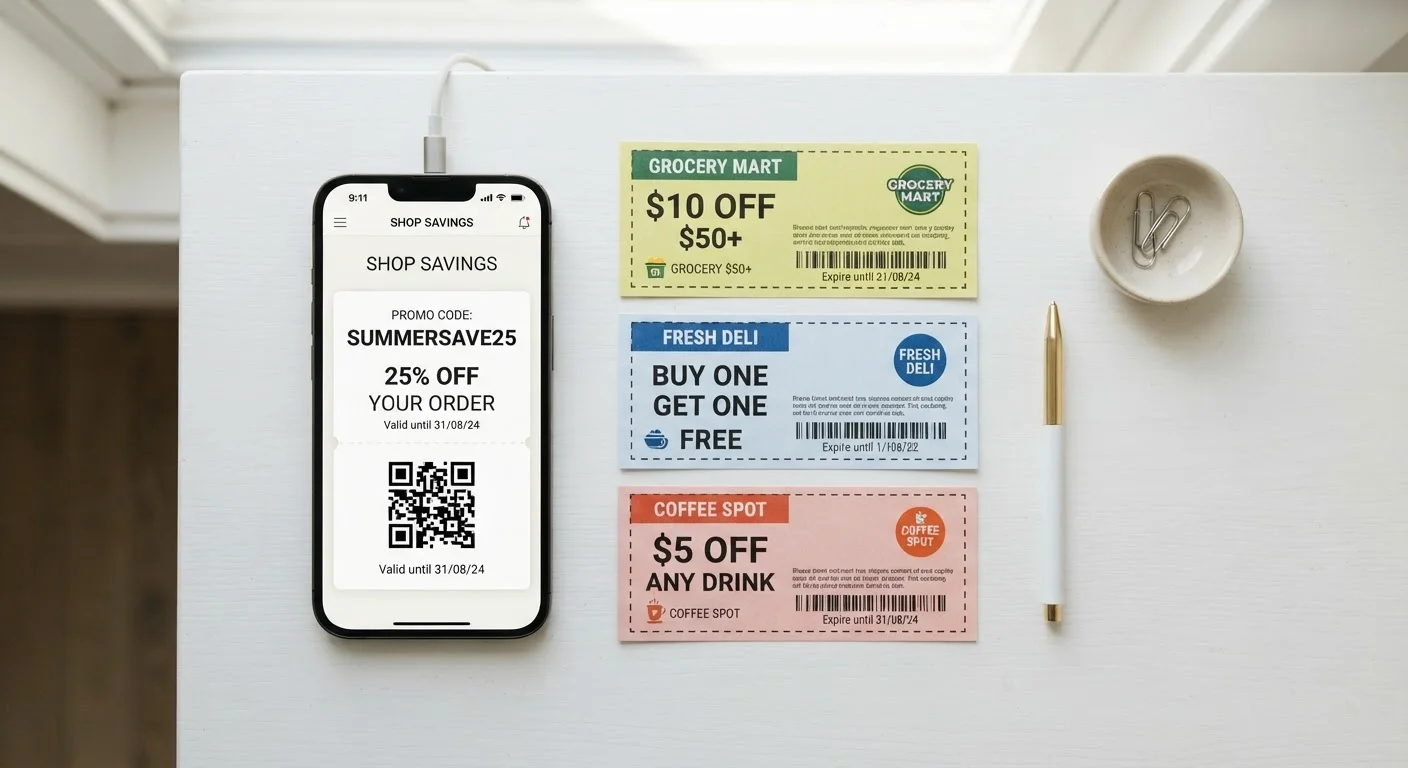
Photo: InsightsVault.com | Interesting Daily Reads editorial
Key Takeaways
- Promo codes are issued and controlled by retailers; manufacturer coupons are issued by product brands.
- Promo codes apply at online checkout; manufacturer coupons can work across multiple qualifying stores.
- Stacking both types is sometimes possible but depends entirely on each retailer's coupon policy.
- Manufacturer coupons follow strict redemption rules enforced by the brand, not just the store.
- Expired or misapplied codes are a leading cause of checkout confusion - terms matter for both types.
Who Issues the Discount - and Why It Matters
The single biggest difference between promo codes and manufacturer coupons is who controls them. A promo code is created and funded by the retailer - an online store, a marketplace, or a subscription service - to drive traffic or clear inventory. A manufacturer coupon, by contrast, is issued by the company that makes the product, and the brand itself reimburses the retailer when you use it.
This distinction isn't just administrative. It shapes where each discount works, what it applies to, and whether you can combine it with anything else. Retailer-controlled discounts can be switched on or off at will, restricted to specific customer segments, or tied to minimum cart values. Manufacturer coupons travel with the product: take the same coupon to a different participating store and it's still valid, because the brand is the one paying for it.
To understand why retailers and brands each choose to offer different kinds of discounts, see where coupons actually come from.
| Criterion | Promo Codes | Manufacturer Coupons |
|---|---|---|
| Issued by | Retailer or platform | Product manufacturer / brand |
| Primary channel | Online checkout | In-store or multi-retailer |
| Reimbursement | Retailer absorbs the cost | Brand reimburses the retailer |
| Portability | Tied to one retailer or site | Valid at any accepting store |
| Expiration control | Retailer sets and changes terms | Brand sets fixed expiration date |
| Product specificity | Can apply site-wide or by category | Tied to exact product, size, or variety |
| Stackability | Depends on retailer policy | Depends on store and retailer policy |
How Each One Works at the Point of Redemption
Promo codes function as alphanumeric strings entered at an online checkout - or, increasingly, applied automatically through browser extensions and retailer loyalty accounts. They deduct a fixed amount, a percentage, or unlock a perk like free shipping. The retailer's system validates the code against its own rules: Is it expired? Does your cart meet the minimum? Is the item in an excluded category?
Manufacturer coupons work differently. Paper coupons are scanned at a register; the store's system verifies the product barcode matches the coupon's requirements, then processes the discount. The store later submits the coupon to a clearinghouse for reimbursement from the brand. Digital manufacturer coupons - common in store apps - automate that same process but still follow the brand's eligibility terms, not just the retailer's.
Both types can fail at checkout for overlapping but distinct reasons. A promo code might be single-use or region-restricted; a manufacturer coupon might be rejected if the exact size or variety doesn't match the fine print. Why that coupon didn't work breaks down the most common redemption failures for both types.
~$3B
Manufacturer coupons redeemed annually in the US
The Association of Coupon Professionals has tracked consistent billion-dollar annual redemption volumes for paper and digital manufacturer coupons in the United States.
35%+
Online shoppers who abandon carts over cost
Multiple e-commerce studies have found that unexpected costs at checkout - including failed promo codes - are among the top reasons shoppers abandon their carts.
Stacking, Combining, and Getting the Most from Both
The practical opportunity - and the complexity - comes when you try to use both at once. Some retailers allow a manufacturer coupon and a store promo code to apply to the same item; others explicitly prohibit it. Retailer policies on coupon stacking vary widely and can change without notice, so always check the fine print before checkout.
When stacking is permitted, the order of operations matters. Generally, the manufacturer coupon applies first (reducing the item's price), and the promo code or store discount applies to the adjusted total. This sequence can significantly change your actual savings, particularly on percentage-based codes.
Timing also affects how much value you extract. Applying either discount during a broader store sale can amplify the total reduction - but be aware that some promo codes are voided when other promotions are active. For a deeper look at how timing interacts with discount value, see how discount timing affects coupon value.
One more note: not every deal is what it appears to be. Common coupon myths covers widespread misconceptions that lead shoppers to overestimate actual savings from both code types.
The content provided on our blog site traverses numerous categories, offering readers valuable and practical information. Readers can use the editorial team’s research and data to gain more insights into their topics of interest. However, they are requested not to treat the articles as conclusive. The website team cannot be held responsible for differences in data or inaccuracies found across other platforms. Please also note that the site might also miss out on various schemes and offers available that the readers may find more beneficial than the ones we cover.