
Unit Pricing vs. Pack Pricing: Which One Actually Saves You More?

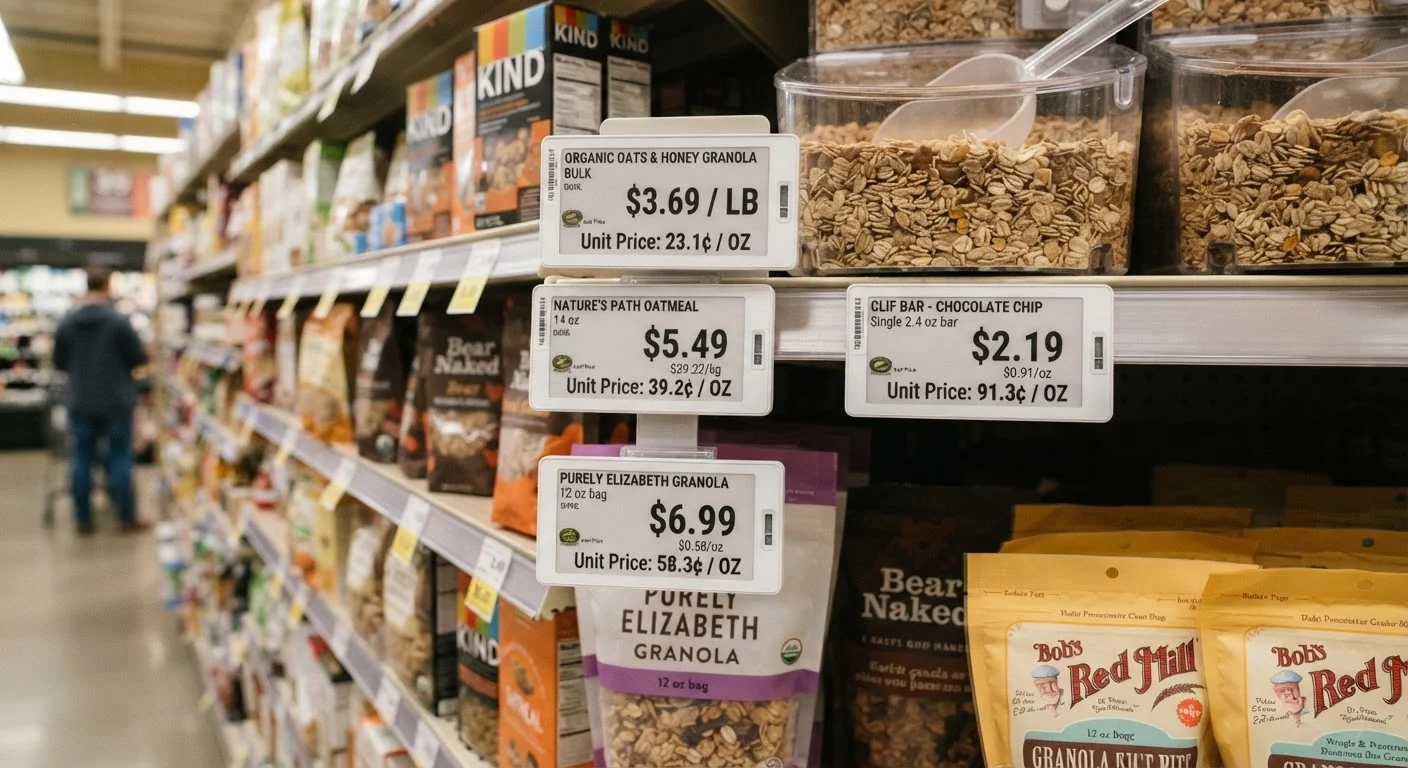
Photo: InsightsVault.com | Interesting Daily Reads editorial
Key Takeaways
- Unit pricing (cost per ounce, count, or liter) is the only reliable way to compare differently sized packages.
- Larger packs often have a lower unit price, but not always - retailers frequently price smaller sizes more competitively.
- Pack pricing alone can mislead shoppers when package sizes change while prices hold steady (a practice known as shrinkflation).
- Unit price labels are legally required in many US states, but the measurement unit used can vary, so verify you're comparing like-for-like.
- Value depends not just on unit price but on whether you'll actually use the product before it expires or degrades.
What Unit Pricing and Pack Pricing Actually Mean
Every item on a retail shelf carries at least one price - the total you pay at checkout. That's pack pricing: the dollar amount for one package, regardless of how much product is inside. It's the number most shoppers see first and, for many, the one that drives the decision.
Unit pricing breaks that total down into a standardized cost - typically per ounce, per count, per liter, or per square foot. Many US states legally require retailers to display this figure on shelf labels, though the specific measurement unit varies by product category and store. When a 32 oz bottle of dish soap costs $4.99 and a 16 oz bottle costs $2.89, the pack prices are easy to spot. The unit prices - $0.156 vs. $0.181 per ounce - tell you which one is actually cheaper per use.
The problem is that pack pricing is designed to be noticed. Unit pricing requires a moment of active attention. That gap in salience is where a lot of money quietly leaves shoppers' wallets.
| Criterion | Unit Pricing | Pack Pricing |
|---|---|---|
| What it measures | Cost per standardized unit (oz, count, etc.) | Total cost for one package |
| Ease of comparison | Direct, objective across sizes | Misleading when sizes differ |
| Shrinkflation visibility | Immediately reveals it | Completely obscures it |
| Shopping speed | Requires a moment to locate label | Instantly visible on price tag |
| Budget planning | Less direct for total spend limits | Clear for managing checkout total |
| Usefulness for perishables | Must factor in spoilage risk | Doesn't account for waste either |
| Reliability across retailers | Varies by state law and store format | Always displayed |
Where Pack Pricing Misleads - and Why It's Not Accidental
Retailers and manufacturers understand that most shoppers anchor on the visible price tag. Several common practices exploit this:
- Shrinkflation: The package price holds steady while the contents quietly decrease. A bag of coffee that was 16 oz becomes 12 oz at the same price - pack pricing looks unchanged, but the unit price has risen about 33%.
- Odd-size packaging: Comparing a 14.5 oz can to an 18 oz can at different price points is difficult mental arithmetic. Unit pricing resolves it instantly.
- Multipack illusions: A "3 for $5" promotion sounds like a deal, but if the single-unit price is $1.59, you're paying more per item by buying the bundle.
These patterns are well-documented in consumer research, and they're consistent across grocery, personal care, and household categories. The categories where pricing diverges most - cleaning products, paper goods, and pantry staples - are also the categories where unit price comparisons yield the greatest potential savings.
~30%
Typical unit price gap between sizes
Consumer research consistently finds unit prices can vary by 20-35% between the smallest and largest available package sizes within a single product line.
60%+
US states with unit pricing laws
More than half of US states have regulations requiring unit pricing disclosure in grocery and retail settings, though enforcement and format requirements differ.
Hundreds annually
Shrinkflation incidents tracked per year
Consumer advocacy organizations and government statistical agencies document hundreds of package-size reductions each year that are not accompanied by proportional price cuts.
How to Use Unit Pricing Effectively in the Aisle
Unit pricing is only useful if you're comparing the same unit across options. Watch for these friction points:
- Mismatched units: One label may show cost per ounce; another shows cost per pound. Convert before comparing (multiply the per-ounce price by 16 to get a per-pound equivalent).
- Count vs. weight: For items like paper towels, "per sheet" is more meaningful than "per roll" since sheet count varies. Verify which unit the label uses.
- Store brands vs. name brands: Unit pricing makes cross-brand comparison objective. A store-brand product at $0.09/oz versus a name brand at $0.14/oz is a 35% difference - regardless of pack price optics.
For perishables, the lowest unit price isn't automatically the right choice. If you won't use a 64 oz container of salsa before it spoils, the lower unit price is irrelevant - you'd be paying for product you'll discard. This is a core theme explored in the real trade-offs of buying in bulk: the math only works if consumption matches purchase volume.
Unit pricing also applies online, though shelf labels give way to product descriptions. When shopping digitally, check the "per unit" line in product listings - some platforms surface it; others require manual calculation. The online vs. in-store comparison often hinges on exactly this factor.
Unit Price Labels Aren't Always Consistent
When Pack Pricing Is the Right Starting Point
Unit pricing doesn't make pack pricing irrelevant - it contextualizes it. There are situations where the pack price is a perfectly reasonable decision input:
- Budget ceiling purchases: If you have $10 to spend on a category, pack price determines how many units you can afford to buy regardless of per-unit efficiency.
- Repeat purchases on familiar products: Once you've done the unit price analysis on a product you buy regularly, pack price is a fast signal for whether the price has changed.
- Single-use or trial items: Testing a new product in a smaller size makes sense even at a higher unit price. Committing to a bulk purchase before you've evaluated quality is a separate risk - one covered in more depth in when spending more upfront actually costs less over time.
Pack pricing is not inherently misleading - it's simply incomplete. The shopper who combines both data points makes better decisions than the one who uses either in isolation. Develop the habit of glancing at the unit price before placing any item in your cart, and pack pricing becomes a useful secondary signal rather than the primary one driving your choices.
The content provided on our blog site traverses numerous categories, offering readers valuable and practical information. Readers can use the editorial team’s research and data to gain more insights into their topics of interest. However, they are requested not to treat the articles as conclusive. The website team cannot be held responsible for differences in data or inaccuracies found across other platforms. Please also note that the site might also miss out on various schemes and offers available that the readers may find more beneficial than the ones we cover.