
When a Repair Bill Exceeds the Car's Value: Thinking It Through

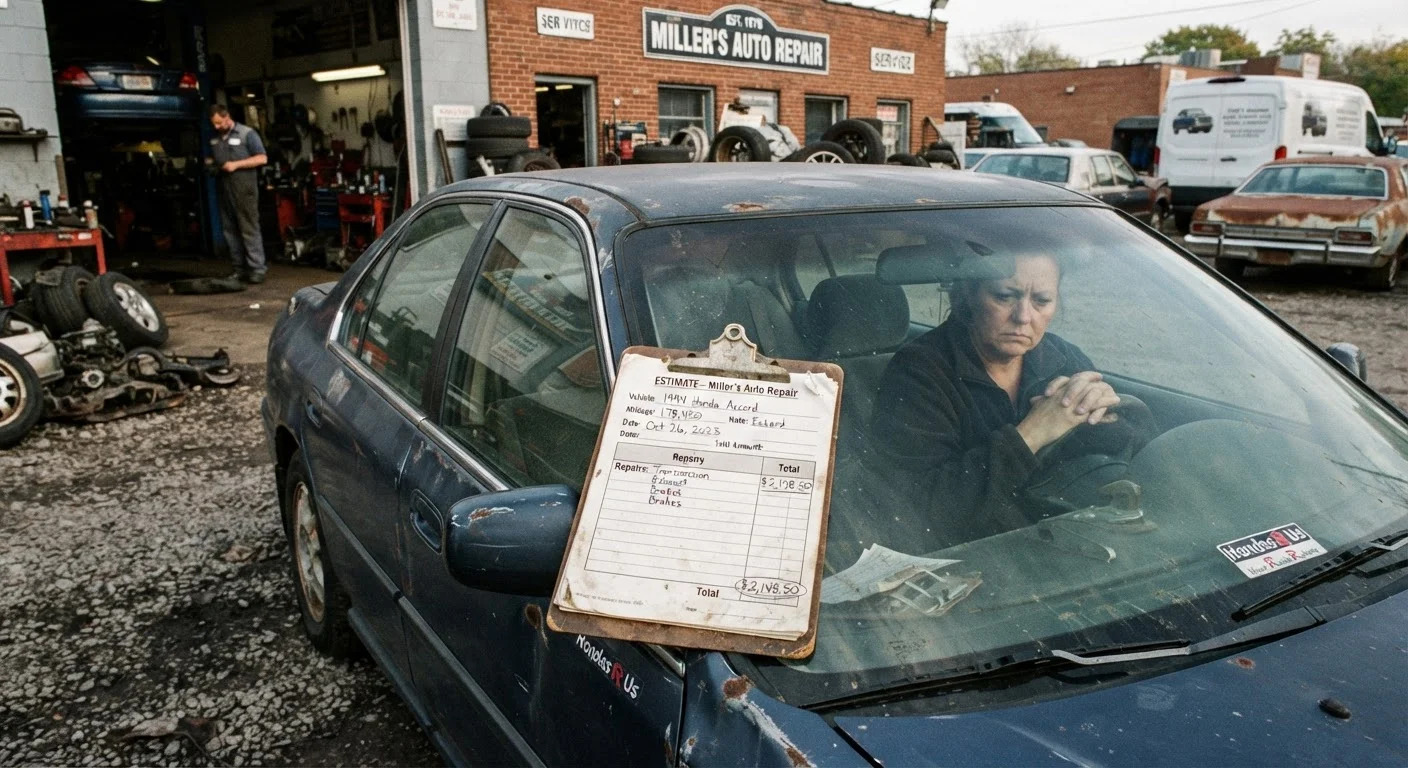
Photo: InsightsVault.com | Interesting Daily Reads editorial
Key Takeaways
- A repair costing more than the car's market value doesn't automatically mean you should walk away.
- Compare the true cost of repair against realistic replacement costs - not sticker prices.
- Your remaining loan balance, insurance payout rules, and daily driving needs all change the math.
- Get a second opinion before committing to any large repair estimate.
- Keeping a paid-off car running often still beats new car payments - but not always.
Avoids taking on new monthly car payments
A paid-off car, even after a large repair, typically costs less per month than a new loan. Average monthly new car payments have remained well above $500 for several years, meaning a $4,000 repair could be recouped in under a year of avoided payments.
You know this car's history
With your current vehicle, you know what repairs have been done, how it's been maintained, and where its weaknesses are. A used replacement comes with its own unknown history and hidden issues.
Insurance costs may stay lower
Older, paid-off vehicles often carry liability-only coverage, which is significantly cheaper than the full coverage most lenders require on financed vehicles. Repairing rather than replacing can preserve that lower insurance expense.
Repair solves a known, specific problem
If the rest of the vehicle is sound, a single large repair addresses a defined issue. A replacement vehicle - especially an older used one - could have multiple unknown problems waiting to surface.
No taxes, fees, or transfer costs
Buying a replacement vehicle adds sales tax, title and registration fees, and potentially dealer fees. These can add $1,000 or more to the true cost of switching vehicles, costs that never appear in a side-by-side repair comparison.
You may be investing in a depreciating problem
If the vehicle has high mileage and a pattern of failures, one large repair may simply delay the next costly breakdown rather than restore reliable transportation. Paying to fix a transmission on a car with a failing engine is rarely sound economics.
Repair costs can escalate once work begins
Mechanics sometimes discover additional damage once a major component is disassembled. An estimate of $4,500 can grow once the shop has access to parts that weren't visible during the initial inspection.
Resale value rarely recovers after major repairs
A $5,000 transmission repair on a $4,000 car does not produce a $9,000 car. Major repairs on high-mileage vehicles almost never increase market value proportionally, limiting your exit options later.
Emotional attachment can distort the decision
Familiarity with a vehicle can cause owners to overestimate its value or reliability. Making the decision based on documented repair history and realistic market comparisons is more reliable than gut feeling.
Opportunity cost of cash outlay
Paying a large repair bill from savings ties up money that could serve as a down payment, reducing the loan needed on a replacement - potentially lowering monthly payments below the repair-and-hold scenario.
Why This Situation Is Trickier Than It Looks
The phrase "the repair costs more than the car is worth" sounds like an obvious verdict. But that framing is misleading, because "what the car is worth" and "what replacing it will cost you" are rarely the same number.
A car valued at $4,000 on a used-vehicle pricing guide might require $5,500 worth of transmission work. That looks like a clear loss - until you price out a comparable replacement and find that anything reliable in your area runs $7,000 to $10,000, with its own unknown repair history. Suddenly the math shifts.
The decision also carries real consequences in both directions. Overpaying to keep an unreliable vehicle running drains money steadily. But rushing into a car payment to avoid one repair bill can cost far more over time. Understanding the full picture before deciding is worth the extra day or two it takes. For a broader look at how these costs accumulate, see the complete financial overview of car ownership costs.
Pros of Paying for the Repair
Choosing to repair - even at a cost that exceeds the vehicle's book value - has real advantages in the right circumstances.
Avoids taking on new monthly car payments
A paid-off car, even after a large repair, typically costs less per month than a new loan. Average monthly new car payments have remained well above $500 for several years, meaning a $4,000 repair could be recouped in under a year of avoided payments.
You know this car's history
With your current vehicle, you know what repairs have been done, how it's been maintained, and where its weaknesses are. A used replacement comes with its own unknown history and hidden issues.
Insurance costs may stay lower
Older, paid-off vehicles often carry liability-only coverage, which is significantly cheaper than the full coverage most lenders require on financed vehicles. Repairing rather than replacing can preserve that lower insurance expense.
Repair solves a known, specific problem
If the rest of the vehicle is sound, a single large repair addresses a defined issue. A replacement vehicle - especially an older used one - could have multiple unknown problems waiting to surface.
No taxes, fees, or transfer costs
Buying a replacement vehicle adds sales tax, title and registration fees, and potentially dealer fees. These can add $1,000 or more to the true cost of switching vehicles, costs that never appear in a side-by-side repair comparison.
One factor often overlooked: a car you already own carries no sales tax, registration transfer fees, or dealer markup. Those costs are invisible when comparing repair bills to replacement sticker prices, but they're very real. Learn more about the recurring costs of car ownership that affect this comparison.
Cons of Paying for the Repair
There are also legitimate reasons to walk away, especially when the numbers or the vehicle's history point in a clear direction.
You may be investing in a depreciating problem
If the vehicle has high mileage and a pattern of failures, one large repair may simply delay the next costly breakdown rather than restore reliable transportation. Paying to fix a transmission on a car with a failing engine is rarely sound economics.
Repair costs can escalate once work begins
Mechanics sometimes discover additional damage once a major component is disassembled. An estimate of $4,500 can grow once the shop has access to parts that weren't visible during the initial inspection.
Resale value rarely recovers after major repairs
A $5,000 transmission repair on a $4,000 car does not produce a $9,000 car. Major repairs on high-mileage vehicles almost never increase market value proportionally, limiting your exit options later.
Emotional attachment can distort the decision
Familiarity with a vehicle can cause owners to overestimate its value or reliability. Making the decision based on documented repair history and realistic market comparisons is more reliable than gut feeling.
Opportunity cost of cash outlay
Paying a large repair bill from savings ties up money that could serve as a down payment, reducing the loan needed on a replacement - potentially lowering monthly payments below the repair-and-hold scenario.
If Your Insurer Has Declared a Total Loss
If your car has been declared a total loss by your insurer, the repair-vs-replace calculation changes significantly. How your policy values the vehicle - market value versus agreed value - determines what payout you'd receive to put toward a replacement. See how agreed value and market value insurance policies compare after a write-off.
How to Make the Decision More Systematically
Rather than reacting to the repair estimate alone, work through these four questions before deciding:
- Get a second estimate. Labor rates and parts markups vary considerably between shops. A $5,500 quote at one garage might come in at $3,800 elsewhere for identical work. Getting a second opinion on car repairs is normal, expected, and often worth several hundred dollars.
- Check the car's overall condition honestly. One large repair is different from a car that needs multiple repairs stacking up. If the transmission is the only major issue on an otherwise sound vehicle, the calculus leans toward repair. If you've already spent significantly this year, that changes things.
- Price replacement realistically. Search actual listings in your area for comparable vehicles - similar age, mileage, and reliability reputation. Include taxes, fees, and the cost of any immediate work a different used car might need.
- Factor in your financing situation. If you still owe money on the car, a repair doesn't eliminate the loan. If you're payment-free, keeping the car running preserves that advantage. Also consider whether staying ahead of maintenance could have prevented or reduced this repair.
$1,000+
Typical taxes and fees on a used vehicle purchase
State and local taxes, title, and registration fees commonly add $1,000 or more to the true cost of replacing a vehicle, a figure rarely included in casual repair-vs-replace comparisons.
~$500/mo
Average new car monthly payment in the US
According to Experian's State of the Automotive Finance Market reports, average new vehicle monthly payments have consistently exceeded $500, making even expensive repairs look different in a monthly cash-flow comparison.
When Walking Away Makes Clearer Sense
Some situations make the decision more straightforward. If the repair addresses a safety-critical system and the shop cannot guarantee the fix will hold, that's a meaningful red flag. Similarly, if the vehicle has a documented history of recurring failures in the same system, one repair may simply delay the next bill rather than resolve the underlying issue.
Owners who rely on their vehicle for work - where a breakdown has direct income consequences - may also reasonably prioritize reliability over the sunk-cost logic of keeping a marginal car going. In those cases, the inconvenience cost of an unreliable vehicle is real money, even if it doesn't appear on a repair invoice.
Avoid the trap of common misconceptions about repair costs that can push you toward either extreme. Repair cost myths regularly distort how drivers perceive their options.
This article provides general information for educational purposes only and does not constitute financial, mechanical, or legal advice. Repair costs, vehicle values, and individual circumstances vary widely. Consult a qualified mechanic and, where relevant, a licensed financial professional before making decisions based on your specific situation.
The content provided on our blog site traverses numerous categories, offering readers valuable and practical information. Readers can use the editorial team’s research and data to gain more insights into their topics of interest. However, they are requested not to treat the articles as conclusive. The website team cannot be held responsible for differences in data or inaccuracies found across other platforms. Please also note that the site might also miss out on various schemes and offers available that the readers may find more beneficial than the ones we cover.