
Dealer Service Centre vs. Independent Mechanic

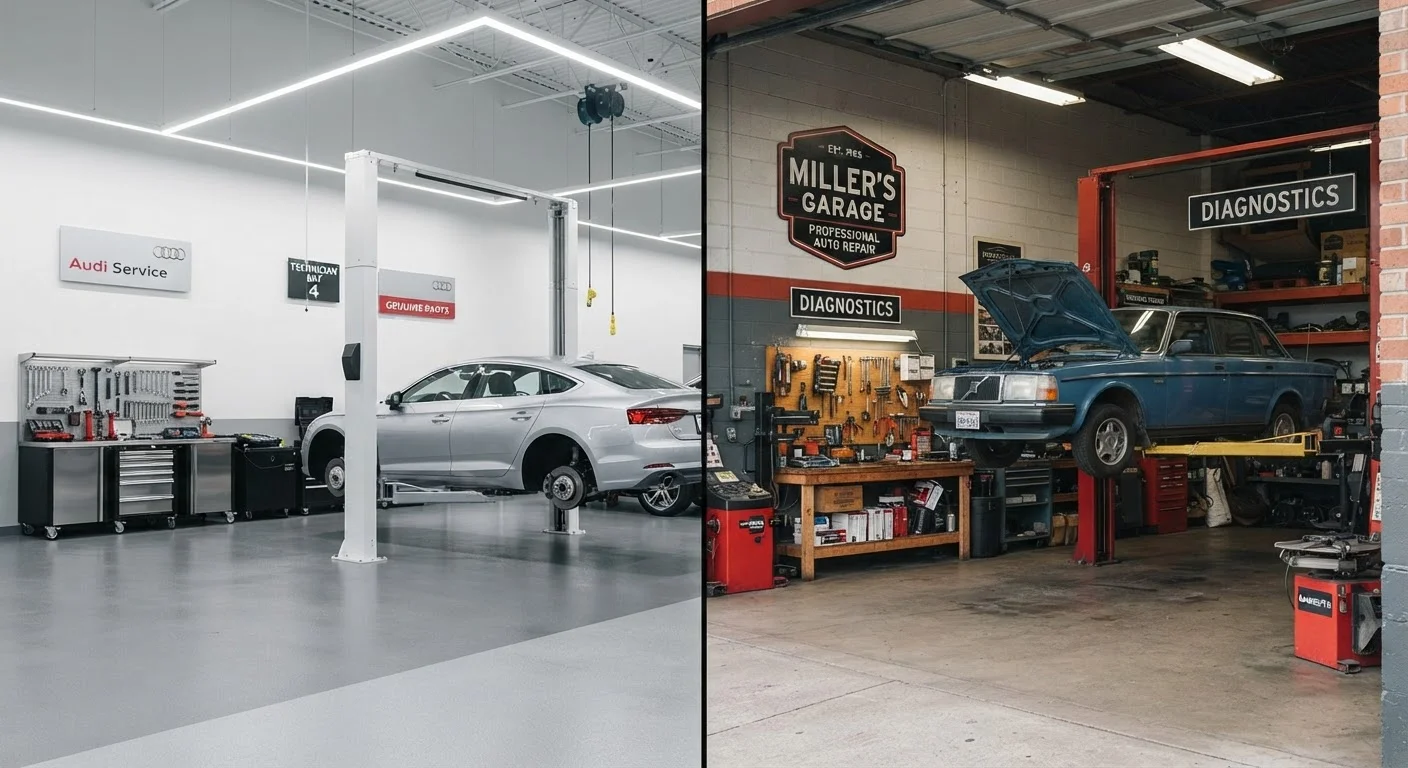
Photo: InsightsVault.com | Interesting Daily Reads editorial
Key Takeaways
- Dealer service centres are not required to maintain your factory warranty - federal law protects your right to use independent shops.
- Independent mechanics typically charge lower labor rates, often 20-40% less than dealerships, though this varies by region and shop.
- Dealers have brand-specific tools and factory training, which matters most for complex electronics and recalls.
- Independent shops can use OEM or quality aftermarket parts - the choice affects cost, quality, and potentially your warranty.
- For routine maintenance on out-of-warranty cars, independent mechanics generally offer the better value proposition.
- Always get a written estimate and ask about parts sourcing regardless of which option you choose.
The Core Difference: What You're Actually Paying For
When you take your car to a dealership service centre, you're paying for brand-authorized infrastructure: factory-trained technicians, proprietary diagnostic software, and a direct line to manufacturer technical support. That infrastructure costs money to maintain, and it shows up in the labor rate. Dealer shop rates commonly run between $130 and $180 per hour, according to general industry benchmarks, though rates vary widely by region and brand.
An independent mechanic operates leaner. Overhead is lower, and those savings are often passed to customers. Independent shops typically charge $80 to $120 per hour for labor - sometimes less in smaller markets. For a job that takes three hours, that gap adds up quickly.
Neither structure is inherently better. The question is whether the dealer's premium buys you something you actually need for your specific car and situation. For a routine service visit, the answer is often no. For a complex fault on a late-model vehicle with advanced driver-assistance systems, the answer may well be yes.
| Criterion | Dealer Service Centre | Independent Mechanic |
|---|---|---|
| Typical labor rate | $130-$180/hr | $80-$120/hr |
| Factory diagnostic tools | Yes, brand-specific | Generic or aftermarket tools |
| Recall work | Yes, at no charge | Not authorized |
| Parts sourcing | OEM, direct from manufacturer | OEM or quality aftermarket |
| Warranty-period servicing | Simplifies warranty claims | Legally permitted; keep records |
| Scheduling flexibility | Often slower; high volume | Often faster; smaller queue |
| Personalized service history | Stored in dealer system | Depends on shop practices |
| Best for vehicle age | Newer, under-warranty cars | Older, out-of-warranty cars |
Warranty Rights: What the Law Actually Says
One of the most persistent myths in car ownership is that using an independent mechanic voids your factory warranty. It does not - at least not automatically. The Magnuson-Moss Warranty Act, a federal consumer protection law, prohibits manufacturers from voiding a warranty simply because you had service performed somewhere other than a dealership, provided the work was done competently and appropriate parts were used.
What can affect your warranty is poor workmanship or the use of parts that caused a specific failure. If an independent shop installs a defective component and that component damages something covered by warranty, the manufacturer may deny that specific claim. But a routine oil change or brake job at a reputable independent shop carries no blanket warranty risk.
The Magnuson-Moss Warranty Act - Key Point
Keep records of every service visit - receipts, part numbers, dates, and mileage. Good documentation protects you whether you use a dealer or an independent shop, and it matters if a warranty dispute ever arises.
Where Each Option Has a Genuine Edge
Dealer advantages are real, but narrow. If your vehicle has an active recall, only a franchised dealership can perform that work, and it's done at no cost to you. Dealers also have factory scan tools that can read manufacturer-specific diagnostic codes that generic OBD-II readers miss. For newer vehicles with complex software, module programming, or hybrid and EV systems, that access can be decisive.
Dealers also tend to have faster access to OEM (original equipment manufacturer) parts for their brand. Understanding the difference between OEM and aftermarket options matters here - see our breakdown of OEM parts vs. aftermarket parts for more detail.
Independent mechanics shine on value and flexibility. A good independent shop can source quality OEM or aftermarket parts at lower markups, complete standard maintenance jobs at meaningfully lower labor rates, and often provide faster scheduling than a busy dealer service department. For the majority of maintenance tasks on vehicles more than three or four years old, this is where the better value typically lives.
Not sure which repairs are even worth taking to a professional versus handling yourself? Our guide on DIY repairs vs. jobs for a pro can help you draw that line before you book any appointment.
How to Make the Choice Confidently
Start with your vehicle's age and warranty status. If you're within the manufacturer's bumper-to-bumper coverage period, using an authorized dealer for anything that might trigger a warranty claim is a reasonable precaution - not because the law requires it, but because it simplifies the claims process.
Once you're out of warranty, shift your focus to finding a reputable independent shop with strong reviews, ASE-certified technicians, and transparent pricing. Don't hesitate to get written estimates from more than one shop - getting a second opinion on repairs is a normal, sensible part of managing car costs, not an awkward confrontation.
When you do speak with any mechanic, ask specifically what parts they plan to use, where those parts come from, and whether the estimate is firm or subject to change. Clear communication before work begins is the single most effective way to avoid bill shock. For a full list of questions worth asking, see our guide on how to talk to a mechanic.
The broader picture of repair and maintenance costs - including how this choice fits into your overall ownership budget - is covered in our complete financial overview of car ownership costs.
This article is for general informational purposes only and does not constitute financial, legal, or mechanical advice. Warranty terms vary by manufacturer and situation; consult your vehicle's warranty documentation and a qualified professional for guidance specific to your circumstances.
The content provided on our blog site traverses numerous categories, offering readers valuable and practical information. Readers can use the editorial team’s research and data to gain more insights into their topics of interest. However, they are requested not to treat the articles as conclusive. The website team cannot be held responsible for differences in data or inaccuracies found across other platforms. Please also note that the site might also miss out on various schemes and offers available that the readers may find more beneficial than the ones we cover.